“The Independent Scholar’s Handbook”: The most inspiring book I’ve ever read about doing scholarship

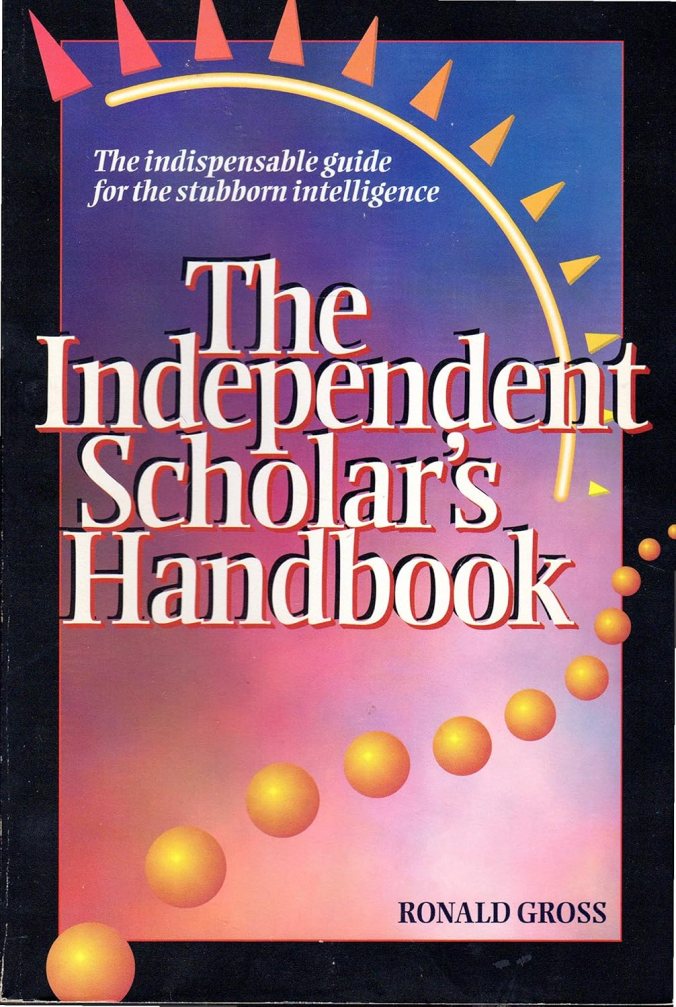
1993 edition of this inspirational, instructive classic

In the summer of 1982, I was browsing through the shelves at a Kroch’s & Brentano’s bookstore in the Chicagoland area, when I spotted a provocative title: The Independent Scholar’s Handbook, by Ronald Gross. After flipping through it for a few minutes, I knew I had to buy it. However, I had no clue that it eventually would become one of the most important books in my life.

I had recognized Ron Gross’s name from an earlier book he had authored, The Lifelong Learner (1976), which I had checked out several times from my local library. In that book, he surveyed and celebrated all the ways in which someone could pursue self-directed learning throughout their lifetime, using libraries, bookstores, learning programs on television, radio, courses on cassette tapes, and more.

The Independent Scholar’s Handbook took Ron’s DIY approach a big step further, providing a vivid look at how one could become an independent producer of knowledge, outside of the halls of academe. Today, over 40 years later, the Handbook — first published in 1982, and revised in 1993 — remains something of an intellectual lodestar for those who regard themselves as independent scholars.

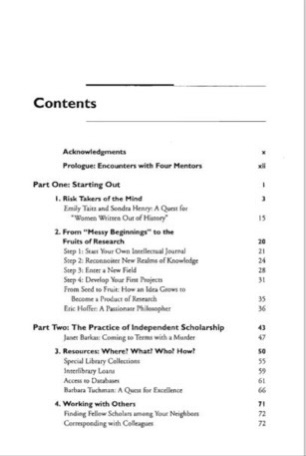
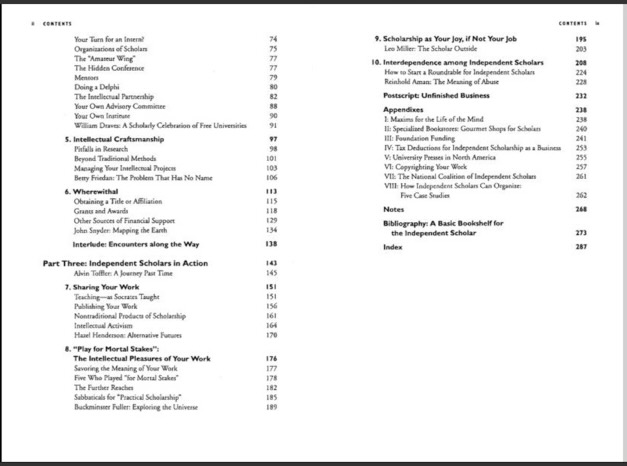
If asked to identify the core qualities of The Independent Scholar’s Handbook, I would say they are lively, inspirational, instructive, and illustrative. Gross shares his boundless enthusiasm for a practice of independent scholarship not limited by traditional academic conventions. He provides concrete advice (albeit from the pre-internet era) on how to go about this. He offers countless stories of independents who have researched and shared with the world influential writings and creative works. The table of contents gives you a good idea of what this eclectic book is all about. (You may have to enlarge your screen view to read this.)
***

When I discovered The Independent Scholar’s Handbook, I was neither independent nor a scholar. In fact, I was spending a year between college and law school, doing odd jobs and living with my parents in northwest Indiana. Later that fall, I would head off to New York City to begin law school at New York University.

Law school presented few opportunities to engage in the kind of lively scholarship that Gross portrayed. I did serve on one of NYU’s student-edited law journals and published a couple of book annotations as part of my responsibilities. But the main work involved editing and citation checking. I regarded the journal experience as more of a (sometimes interesting) chore, in return for a credential that would help me in the job market.

Nevertheless, The Independent Scholar’s Handbook was among the books I had brought with me from Indiana. I kept returning to it again and again. The sense of adventure and excitement of doing scholarly work in a more freeing, independent mode remained with me.

Once I became a full-time academic, I found that The Independent Scholar’s Handbook was influencing how I approached my own scholarship. The book planted intellectual seeds in at least three important ways:

  • Inspired by the stories of independent scholars contained in the book, I was imbued with the conviction that the fruits of one’s research and scholarship should have a public life.
  • I was drawn to the practice of research and scholarship based on one’s interests, even passions, rather than simply trying to please a tenure committee (although I would successfully jump through that hoop).
  • I quickly embraced the happy reality that scholarly exploration was not the sole province of full-time academics, which eventually led me to forge a personal, interdisciplinary network of scholars (both affiliated and independent), practitioners, writers, artists, researchers, activists, and lifelong learners.

I discuss many of these points in a law review article, “Intellectual Activism and the Practice of Public Interest Law,” published in the Southern California Review of Law and Social Justice, freely downloadable here.

The Handbook would also introduce me to independent scholars who have become significant in my intellectual life, including adult educator John Ohliger (whose work inspired the title of this blog) and philosopher Charles Hayes. I had the pleasure of meeting Ron Gross in person when I organized a program at my school featuring his book Socrates’ Way,

***

Now that I’ve entered a voluntary phased retirement program at my university, I look forward to doing more work that reflects the ethos of, and practices embodied in, The Independent Scholar’s Handbook. Although I will continue to do some more traditional legal scholarship, I look forward to engaging in other types of writing and public education projects. I’m quite excited by the possibilities.

***

And I have GREAT NEWS! Although The Independent Scholar’s Handbook has been out-of-print for some time, you may freely download a pdf version of the updated, 1993 edition from the Internet Archive by clicking here. (It’s also possible to hunt down hard copies of both editions on eBay. Avoid those listed at bizarrely exorbitant prices.)

IN ADDITION, the National Coalition of Independent Scholars, a membership organization for indie scholars delving into any subject matter, has published its NCIS Guide for Independent Scholars (2024), edited by Amanda Haste and Linda Baines, with a Foreword by none other than Ron Gross! You may freely access a pdf of the book by clicking here.
My life of the mind: Embracing transitions

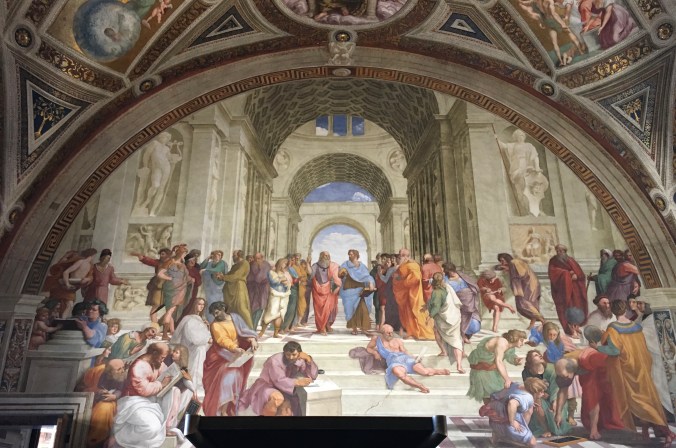
Raphael’s School of Athens (Apostolic Palace, The Vatican; photo: DY)

Since 1991, I’ve been a full-time law professor.  But that’s changing now. I’ve entered a voluntary phased retirement program at Suffolk University Law School in downtown Boston, where I’ve been teaching since 1994.  Starting with the current academic year, I’m on a half-time teaching schedule, and will remain so for the following two academic years. Although I may continue to teach on a very part-time basis after that, I am concluding my full-time employment as a law professor.

Although I still enjoy teaching our wonderful students at Suffolk, I’m delighted to be transitioning into a busy and fulfilling semi-retirement. I’ll be engaging in a variety of lifelong learning and cultural enrichment activities, volunteer service on various non-profit boards and advisory committees, and ongoing aspects of my long-time work. I’ll also do hobbies and spend more time with people dear to me.

As part of this transition, I’m looking at how my various learning and related activities are shaping up. Here’s how things are looking for now:

Great Books and Great Ideas

In 2024, I completed the Basic Program of Liberal Education for Adults, offered since 1946 by the University of Chicago’s Graham School for Continuing Liberal and Professional Studies. As I wrote earlier on this blog:

The Basic Program is an open enrollment, non-credit, four-year sequence of courses featuring the close reading and discussion of what have been called the Great Books. It starts with works by ancient Greek philosophers and poets and proceeds to examine other canonical authors and works of the Western tradition.

The Basic Program experience was so meaningful, both intellectually and personally, that I’ve continued to take elective courses and course sequences at Graham. Right now I’m enrolled in a series of courses titled “The End(s) of Humanity,” which uses the lens of the humanities to consider existential crises such as climate change and the nuclear threat. Meeting every Saturday morning in the company of two remarkable instructors who are designing these courses and a very smart cohort of fellow adult learners, this is a fascinating and compelling inquiry into major challenges of our day.

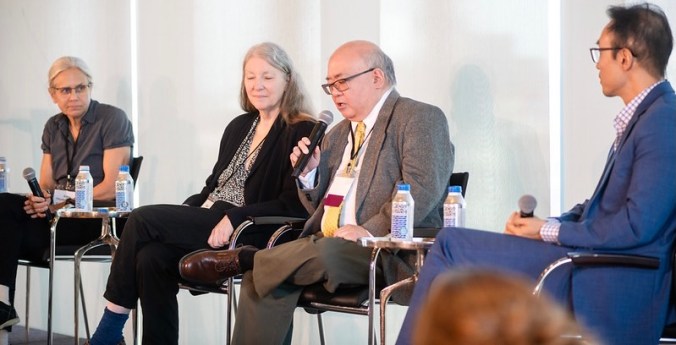
Furthermore, I’ve added a service component, jumping into this U of Chicago thing with both feet. Last year, I accepted an invitation to join the Graham Council, a volunteer body appointed by the University’s board of trustees that supports the Graham School and provides input and feedback to its administrators and faculty. And in the fall, I participated in a panel discussion on the value of reading Great Books and gave an interview for a video commemorating the upcoming 80th anniversary of the Basic Program

Offering remarks during a U Chicago Graham School panel discussion on the value of reading the Great Books, Hyde Park, Chicago

I now regard the Graham School as a vital long-term home base for my lifelong learning activities. My service role with Graham also enables me to support the liberal arts and humanities generally. In sum, this has become an enormously enriching and satisfying association.

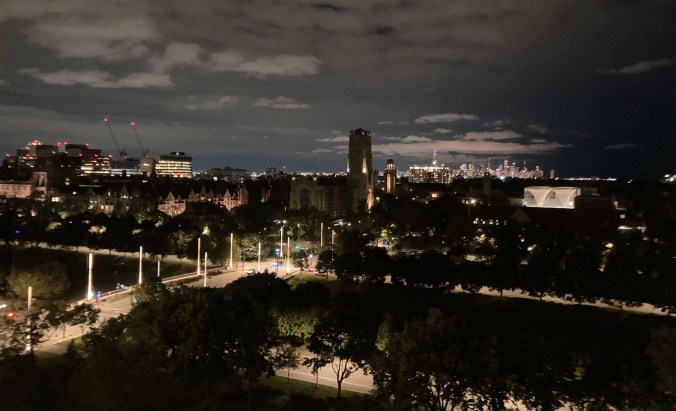
University of Chicago, Hyde Park, Chicago (photo: DY)

Singing

I am passionate about . . . ” is probably one of the most overused expressions of our day. But dear reader, I am truly passionate about singing as a very meaningful, fun, and healthy hobby and pastime.

Since 1995, I’ve taken a weekly singing workshop with the same instructor, Jane Eichkern, first at the Boston Center for Adult Education, now at the Cambridge Center for Adult Education. Taught in a supportive, encouraging small class format, it has been a locus of learning, fun, and fellowship. It has been part of the rhythm of my life, going back to my first year in Boston. I have not missed enrolling in a term since I first signed up.

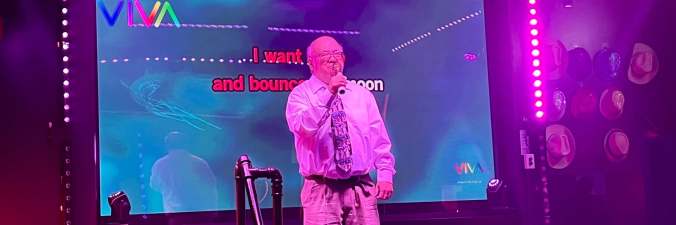
During recent years, I’ve become a big karaoke enthusiast as well. My go-to venue is the main stage at VIVA Karaoke & Studios in Boston’s Theatre District. Before the pandemic, I had become a regular at VIVA’s predecessor, Limelight Karaoke. When they reopened under the VIVA name, I returned and have kept returning.

I’m singing a fave Sinatra tune at the VIVA Karaoke main stage in Boston

I love singing the old standards, also referred to as the Great American Songbook. Songs popularized by the likes of Sinatra, Tony Bennett, Bobby Darin, and others are among my favorites. (If you’re on Facebook, you can check out three of these croonings here, here, and here!)

I harbor enormously modest singing ambitions: I want to be a great karaoke singer. That’s it! I’ve resisted suggestions to expand my vistas by seeking out a choral group or local theatre company to join. Voice class and karaoke are my happy places.

History

I have been an amateur student of history going back to grade school. This next chapter of my life will allow me more time to dive into learning about and understanding our past. Fortunately, I live in a city that is simply steeped in history. Among other things, Boston played significant roles in the lead-up to American Revolution and in the anti-slavery movement that led into the American Civil War. The city is a casebook of early Americana.

Here, too, a service component is part of my interest. I’m forging a very rewarding connection to the world of public history via my service on the board of directors of Revolutionary Spaces, Inc., a Boston-based non-profit institution. Rev. Spaces stewards two nationally significant historic sites — the Old South Meeting House and the Old State House, both located in downtown Boston — and offers public education exhibits, tours, and programs about American history, democracy, and freedom of speech. I began attending Rev. Spaces events in 2023. I was so impressed by the quality of programs and staff there that I basically enthused my way onto the board.

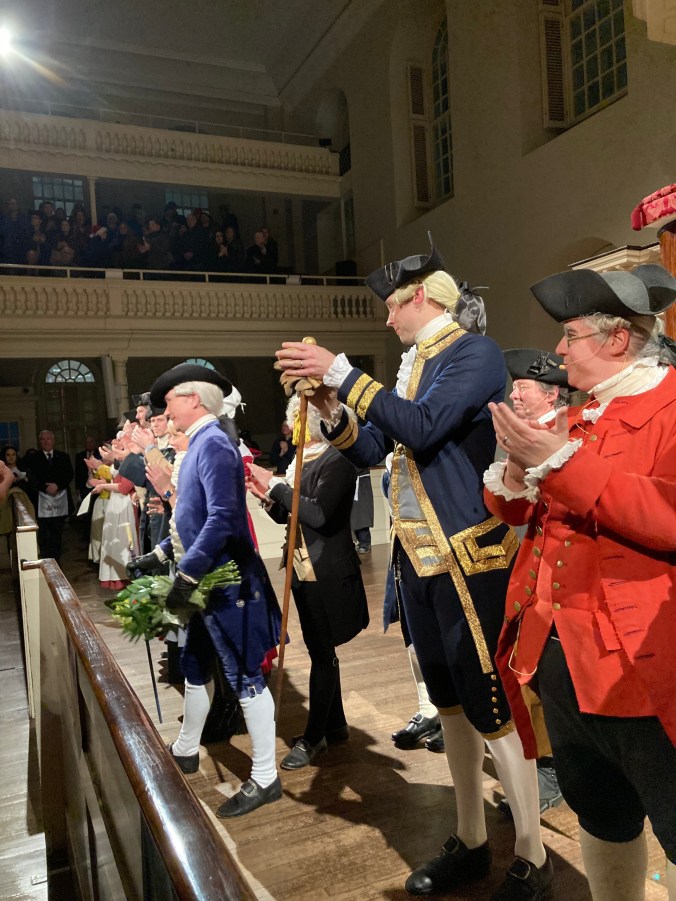
Performers take their bows at the annual interactive Rev. Spaces re-enactment of the raucous 1773 public meeting that preceded the Boston Tea Party, at the site where it happened (Old South Meeting House, Boston; photo: DY)

These on-site opportunities join with hundreds of books about history that are part of my personal library, many of which await closer attention during my semi-retirement. With a bit of luck and good health, the upcoming years will allow me to satisfy more of my history geek leanings.

Non-Scholarly Writing Projects

I’m looking forward to doing more non-scholarly writing during the years to come. This includes social media contributions and articles for periodicals.

In addition, I want to explore some non-traditional venues. Before I began my teaching career, I was very drawn to the world of zines — little magazines and short booklets, often self-published — and imagined myself someday publishing in that mode. Well, the publication expectations of academe took over at that point, to the extent that even serious blogging (of which I’ve done a ton) isn’t considered to be academic writing by many people in this business.

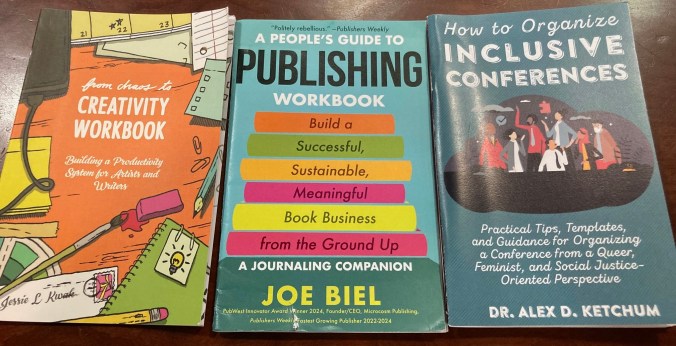
But with my schedule becoming more flexible, I’m starting to explore what continues to be a thriving zine world. Lately I’ve been spending a lot of time with offerings from Microcosm Publishing, and I’ve got several ideas for zine writing that might be interesting to some readers out there.

Part of my latest zine haul from Microcosm Publishing (photo: DY)

Legacy Work

Finally, although I will no longer be a full-time law professor, I will remain professionally active in focal areas that have shaped my academic work for decades, such as workplace bullying, employee safety and dignity, and therapeutic jurisprudence.

I’ve been doing this workplace anti-bullying stuff for a long time, and I have no intentions to stop.

This will include advocating for the enactment of workplace anti-bullying laws in the U.S., engaging in research, writing, and public education projects about creating healthier workplaces, and supporting the evolution of the law through application of mental health and psychological insights to law and public policy. You may read more about my work at my Minding the Workplace blog, which I have been writing since 2008, and download many of my scholarly writings without fee from my Social Science Research Network page.

******

My various activities will keep me downing coffee on a regular basis (photo: DY)

When I began thinking hard about what I would like this next chapter of my life to look like, education and lifelong learning naturally emerged as a recurring theme. These realms include higher education, adult education, and popular education, and they involve both personal learning and service components. I’m very much looking forward to it all.

(Revised: March 2026)