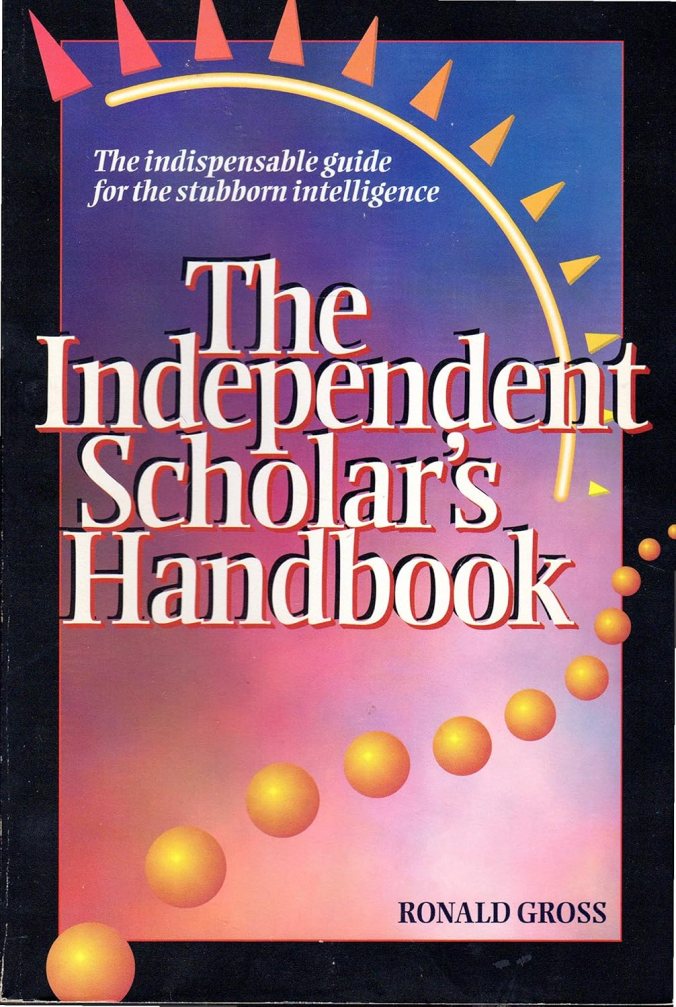
1993 edition of this inspirational, instructive classic
In the summer of 1982, I was browsing through the shelves at a Kroch’s & Brentano’s bookstore in the Chicagoland area, when I spotted a provocative title: The Independent Scholar’s Handbook, by Ronald Gross. After flipping through it for a few minutes, I knew I had to buy it. However, I had no clue that it eventually would become one of the most important books in my life.
I had recognized Ron Gross’s name from an earlier book he had authored, The Lifelong Learner (1976), which I had checked out several times from my local library. In that book, he surveyed and celebrated all the ways in which someone could pursue self-directed learning throughout their lifetime, using libraries, bookstores, learning programs on television, radio, courses on cassette tapes, and more.
The Independent Scholar’s Handbook took Ron’s DIY approach a big step further, providing a vivid look at how one could become an independent producer of knowledge, outside of the halls of academe. Today, over 40 years later, the Handbook — first published in 1982, and revised in 1993 — remains something of an intellectual lodestar for those who regard themselves as independent scholars.
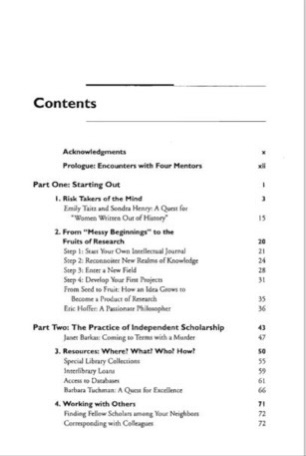
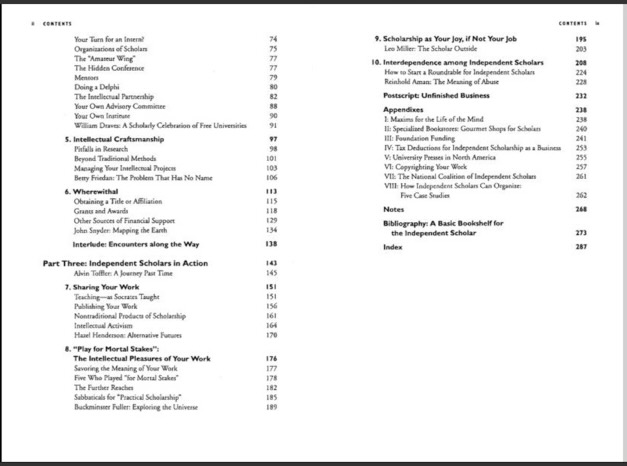
If asked to identify the core qualities of The Independent Scholar’s Handbook, I would say they are lively, inspirational, instructive, and illustrative. Gross shares his boundless enthusiasm for a practice of independent scholarship not limited by traditional academic conventions. He provides concrete advice (albeit from the pre-internet era) on how to go about this. He offers countless stories of independents who have researched and shared with the world influential writings and creative works. The table of contents gives you a good idea of what this eclectic book is all about. (You may have to enlarge your screen view to read this.)
***
When I discovered The Independent Scholar’s Handbook, I was neither independent nor a scholar. In fact, I was spending a year between college and law school, doing odd jobs and living with my parents in northwest Indiana. Later that fall, I would head off to New York City to begin law school at New York University.
Law school presented few opportunities to engage in the kind of lively scholarship that Gross portrayed. I did serve on one of NYU’s student-edited law journals and published a couple of book annotations as part of my responsibilities. But the main work involved editing and citation checking. I regarded the journal experience as more of a (sometimes interesting) chore, in return for a credential that would help me in the job market.
Nevertheless, The Independent Scholar’s Handbook was among the books I had brought with me from Indiana. I kept returning to it again and again. The sense of adventure and excitement of doing scholarly work in a more freeing, independent mode remained with me.
Once I became a full-time academic, I found that The Independent Scholar’s Handbook was influencing how I approached my own scholarship. The book planted intellectual seeds in at least three important ways:
- Inspired by the stories of independent scholars contained in the book, I was imbued with the conviction that the fruits of one’s research and scholarship should have a public life.
- I was drawn to the practice of research and scholarship based on one’s interests, even passions, rather than simply trying to please a tenure committee (although I would successfully jump through that hoop).
- I quickly embraced the happy reality that scholarly exploration was not the sole province of full-time academics, which eventually led me to forge a personal, interdisciplinary network of scholars (both affiliated and independent), practitioners, writers, artists, researchers, activists, and lifelong learners.
I discuss many of these points in a law review article, “Intellectual Activism and the Practice of Public Interest Law,” published in the Southern California Review of Law and Social Justice, freely downloadable here.
The Handbook would also introduce me to independent scholars who have become significant in my intellectual life, including adult educator John Ohliger (whose work inspired the title of this blog) and philosopher Charles Hayes. I had the pleasure of meeting Ron Gross in person when I organized a program at my school featuring his book Socrates’ Way,
***
Now that I’ve entered a voluntary phased retirement program at my university, I look forward to doing more work that reflects the ethos of, and practices embodied in, The Independent Scholar’s Handbook. Although I will continue to do some more traditional legal scholarship, I look forward to engaging in other types of writing and public education projects. I’m quite excited by the possibilities.
***
And I have GREAT NEWS! Although The Independent Scholar’s Handbook has been out-of-print for some time, you may freely download a pdf version of the updated, 1993 edition from the Internet Archive by clicking here. (It’s also possible to hunt down hard copies of both editions on eBay. Avoid those listed at bizarrely exorbitant prices.)
IN ADDITION, the National Coalition of Independent Scholars, a membership organization for indie scholars delving into any subject matter, has published its NCIS Guide for Independent Scholars (2024), edited by Amanda Haste and Linda Baines, with a Foreword by none other than Ron Gross! You may freely access a pdf of the book by clicking here.

