A book about notebooks: “The infinite potential of the blank page”

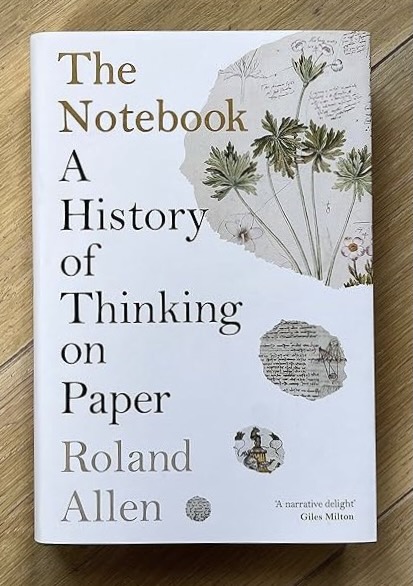
(Image: Roland-Allen.com)

During the pandemic, I found myself resorting to printed notebooks to jot down ideas and impressions, write mini-essays, develop plans, and make lists. I think I was getting so tired of living my life online that I became specially drawn to the analog appeal of deploying pen and paper for recording my thoughts. 

As for the notebooks themselves, I went both highbrow and budget level, using both pricey Moleskine books and inexpensive Mead composition books. I tended to write the more “profound” stuff in the Moleskines, while putting everyday notes and numbers into the composition books.

Today, I’ve kept up the notebook habit, especially for brainstorming over potential projects, developing ideas, and planning for the coming weeks, months, and years. I feel like I’m in a mental comfort zone when I’m in this notebook writing mode.

***

It should be no wonder, then, that I was delighted to discover Roland Allen’s marvelous The Notebook, A History of Thinking on Paper (2023). The book’s title doubles as its description. Allen chronicles in fascinating detail how both prominent and everyday people have used notebooks or their historical predecessors, going back to the days of stone tablets.

Allen’s long introduction starts us in the present, exploring the Moleskine notebook phenomenon and the underlying draw of this brand and others in our digital age. It reassured me that I have not been alone in experiencing the attraction of printed notebooks, even if in some ways it’s easier for us to simply open our laptops and start typing away.

In trying to nail down that appeal, the caption accompanying a photo of a modern notebook explained the heart of it for me: “The infinite potential of the blank page.” Awesome.


On studying the “Great Books” at the University of Chicago: A deeply satisfying finish and a glorious failure

Certificate and graduation program

During June, I made a quick trip to Chicago to attend my graduation ceremony from the University of Chicago’s storied Basic Program of Liberal Education for Adults. The Basic Program is an open enrollment, non-credit, four-year sequence of courses featuring the close reading and discussion of what have been called the Great Books. It starts with works by ancient Greek philosophers and poets and proceeds to examine other canonical authors and works of the Western tradition. The Basic Program is offered through the U of C’s Graham School of Continuing Liberal and Professional Studies, one of the University’s three original academic units, dating back to its founding in the early 1890s.

The Basic Program has been a long-time Graham School staple, solidly rooted in the Great Books movement championed by the likes of U of C President Robert Hutchins, Columbia University professor John Erskine, and iconoclastic educator Mortimer Adler during the early and mid 20th century. Traditionally offered in a small group, in-person format in the Chicagoland area, the Basic Program began piloting an online version during the years preceding the pandemic. When COVID arrived, everything moved online.

The pandemic had prompted me to search for interactive, online learning opportunities that might soften the isolation of spending so much time at home. I had known about the Basic Program for many years, but I assumed it would remain an in-person offering only. However, I wondered if the pandemic had prompted a change, and it had indeed. I would enroll in the Fall of 2020.

As I wrote on this blog in early 2021, reading some of the important works that comprised the Basic Program curriculum had long been on my radar screen, but I knew that I couldn’t do it alone:

I can be a person of contradictions. I have long resisted required courses and curricula at just about every stage of learning in my life, going back to grade school. If a subject doesn’t interest me, then I don’t want to sink any time into it.

But here I am, delighted to participate in a four-year, prescribed curriculum of courses and books.

You see, I have long wanted to read the classics of the Western tradition, considering this to be a big gap in my education. To the extent that I have a “bucket list,” reading these works has been on it.

The problem is that I’m just not self-disciplined enough to read the Great Books on my own. They require a sustained, concentrated commitment. Although I don’t need the prod of tests and quizzes, I do need the presence of a teacher and fellow learners, along with a set schedule.

That’s exactly what the Basic Program provides. The instructors are dedicated, gifted teachers in the Socratic tradition, and they facilitate dialogues among very bright fellow students who are excited about participating in this course of study.

In a notebook that I kept during 2020-21 to record assorted thoughts, ideas, and plans, I jotted down why I wished to undertake this considerable investment of time and attention. I concluded, with a somewhat dramatic, self-important flourish, that “I want to be an educated man.” I figured that four years of immersive study of the Great Books, guided and inspired by Basic Program instructors and fellow students, would help me achieve that objective.

Graduation

I will be writing more about the intellectual substance of being in this program later. But for now, let me fast forward back to the point where I’m in Chicago last month for our graduation festivities. Our weekend was a deeply satisfying way to finish the four-year journey, the 74th graduation ceremony in the Basic Program’s history. It was such a delight to meet many of my instructors and classmates in person for the very first time, after spending literally hundreds of hours together on Zoom.

We started with a Saturday dinner for our cohort, hosted by one of our classmates. Sunday morning and afternoon included an opening breakfast hosted by the Basic Program for donors to the class gift, followed by the graduation ceremony itself, and then an informal lunch with several classmates.

Although our online cohort of some 14-15 students greatly enjoyed each others’ contributions to our class discussions and had developed a genuine rapport, it remained to be seen how we would interact when we got together in-person for the first time. It turned out that we had little to worry about on that note. Graduation weekend was like meeting old friends.

Glorious failure

The Basic Program started as a welcomed and engaging focal point during the heart of the pandemic. It finished as a rewarding intellectual and personal experience, spent in the good company of a very special group of fellow learners and instructors.

But in one way, it was a glorious failure. Recall my notebook jotting that I wanted to enroll in the program to become “an educated man.” During our final quarter together and continuing into our graduation weekend, I found myself pondering that original objective. I realized that the greatest intellectual gift of the Basic Program was that it constituted a jumpstart, not a finish, to my education. 

Indeed, during these four years, I was constantly reminded of how much I didn’t know, thanks in part to my responses to our assigned readings, but mostly due to the richness of our class discussions and insights shared by others in the room. I can’t even begin to count how many times someone’s thoughtful comment, pointed observation, or shared piece of knowledge led me to think, omigosh, I wouldn’t have thought of that in a million years.

And so, I find myself looking forward to more learning adventures, including additional classes through the Graham School. They will provide rewards as sheer intellectual experiences, as well as lenses for examining contemporary life. In fact, the experience of this program has led me to conclude that deep reading and contemplation of important works can help us understand the unsettling and illiberal (i.e., intolerant and narrow-minded) condition of our broader society today. I’ll be sharing a few of those lessons in future postings.

The Basic Program at the University of Chicago: “Senior year” beckons

The Big One awaits

This month, I am starting my fourth and final year of the Basic Program of Liberal Education for Adults at the University of Chicago’s Graham School. The Basic Program is an open enrollment, non-credit, four-year sequence of courses featuring the close reading and discussion of what have been called the Great Books. It starts with works by ancient Greek philosophers and poets (e.g., Plato, Aristotle, Homer) and proceeds to examine other canonical authors and works of the Western tradition (e.g., Shakespeare, the Bible, Kant).

Here’s how the Basic Program describes itself:

The Basic Program of Liberal Education for Adults is a rigorous, noncredit liberal arts program that draws on the strong Socratic tradition at the University of Chicago and covers the foundations of Western political and social thought.

***

The starting point for the Basic Program is the Four-Year Core Curriculum. Each year is made up of three 10-week Quarters. New Students begin in Year 1 Autumn. They choose from morning, afternoon, or evening sections held online and earn a certificate upon completion of the entire curriculum.

***

Each section meets for three hours once a week. Class sections consist of: a 90-minute seminar (discussing several texts) with one instructor, a 90-minute tutorial (discussing a single text) with a different instructor, with a 15-minute break in between.

Bucket listed

I had long considered studying the Great Books a personal bucket list item, a significant piece of unfinished business in my education. My undergraduate school, Valparaiso University, is home to an excellent honors college built around the Western canon. But after sampling two of its literature courses as a not very intellectual post-adolescent, I just wasn’t interested in that course of study.  But over the years, I began to feel an increasingly strong tug to give these books a try. On occasion, I would try to read some of these great works on my own. These soon-halted efforts taught me that it wasn’t going to happen outside of a more structured learning environment.

I assumed that retirement might provide me with that opportunity. But perhaps there’s nothing like a global pandemic to help you identify and prioritize your options. I had known of the Basic Program for many years. However, originally it was offered only via in-person classes in Chicago, which precluded my enrollment given my Boston residence. Then, during the summer of 2020, I learned that the Basic Program was being offered online, so I quickly investigated.

Even though there are no papers, quizzes, or exams, class sessions are built around expectations of significant student participation. So if I wanted to make the most of this opportunity, I knew that fairly beefy weekly reading assignments would be part of the deal. Although I quickly grasped that this would be a major commitment — for four years, no less — it was an easy decision to sign up.

I now have three years of the Basic Program under my belt. It has been a stimulating, intellectually rewarding experience. I have enjoyed my fellow students and our instructors. The Program has also required a lot of brain work! During busy times with my own work and philanthropic obligations, keeping up with the reading has been challenging. On occasion I’ve made it to class having basically skimmed the material, which is wholly inadequate preparation for two 90-minute sessions featuring intense and close examination of classic texts. But I’ve never regretted enrolling for a minute.

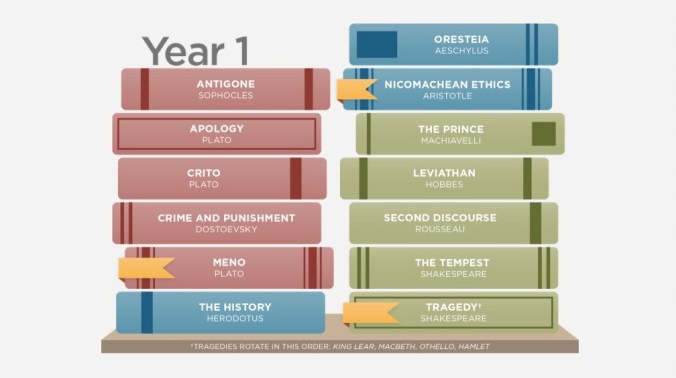
At some point, I will write more about my overall experience in the Basic Program. For now, if you’re curious about what a typical year’s reading in the Program looks like, here is the first-year curriculum. The three colors represent the autumn, winter, and spring quarters. The titles with a banner are for our tutorial courses, which means we spend the entire term on that book alone. The remaining titles are for our seminar courses, which means we cover all or parts of those books, in a more brisk fashion, during the term. (Hamlet, by the way, was our cohort’s Shakespearean tragedy.) For more about the full four-year curriculum, please go here.

“Senior year” beckons

Soon I will join fellow students in our cohort via Zoom to begin what some of us are humorously calling our senior year. In some ways, it feels like we’ve been on quite a journey together already.

During the autumn quarter, our tutorial sessions will be devoted to Thucydides’s History of the Peloponnesian War, written during the late 5th century B.C. This book is a foundational work of history and international relations, chock full of insights relevant to contemporary events. It is required reading at the U.S. military war colleges because of the lessons it holds for understanding modern statecraft.

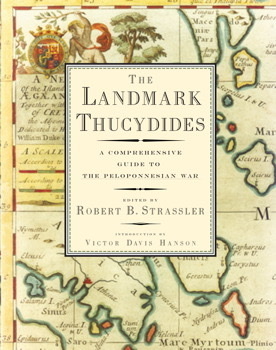
Thucydides has ranked high on my bucket list of books for many years, but an attempt to read it on my own years ago left me rather intimidated. That’s why I was delighted to see it on the Basic Program reading list, knowing that I will benefit from reading and discussing it with my classmates and instructor.  We’ll be using a much-praised edition, The Landmark Thucydides (1998), edited by Robert Strassler, that includes not only a highly respected translation of the primary text, but also lots of supplementary material to fill in our understanding of the pertinent cultural and political dimensions of ancient Greece. 

What else is on the reading list for this term? Our seminar sessions will cover Plato’s Symposium, selected chapters from Plutarch’s Lives of the Noble Greeks and Romans, and Jane Austen’s Pride and Prejudice. Although I encountered the Symposium in college, the other two authors and books are new to me.

And so, a busy “senior year” approaches, to be juggled along with work and other commitments. I hope it is a satisfying and enjoyable journey.

2022 side gig: Serving as a “Fellow in Ideas” at Harrison Middleton University

This year, I’m delighted to be doing an important “side gig” endeavor as a 2022 “Fellow in Ideas” at Harrison Middleton University (HMU), an online university devoted exclusively to the exploration of Great Books and Great Ideas.  Those selected as Fellows contribute reviews and essays to HMU’s publications and join in various discussion groups.

So far, my participation has included:

I look forward to taking part in more HMU activities to round out my fellowship experience during the fall.

Harrison Middleton University is a unique educational entity. Its strongest intellectual roots trace back to Great Books of the Western World, a series of books first published by the Encyclopedia Britannica in 1952, comprised mostly of full works by selected authors of the Western canon. HMU has obtained national accreditation through the Distance Education Accrediting Commission (DEAC). Whereas many DEAC-accredited members are for-profit institutions emphasizing vocational preparation, HMU is a non-profit, online university devoted solely to the liberal arts.

HMU’s work is especially needed during a time when independent inquiry, liberal learning, and the Great Books are on the decline in much of standard-brand higher education and under attack from the social and political extremes. It is a gift to be a year-long visitor to this stimulating, intelligent, and welcoming community.

Walking the streets of Ye Olde London Towne: When a big book satisfies

My current streaming devotion is Netflix’s “The Frankenstein Chronicles” (2 seasons, 2015-17), a mystery and horror drama set in early 19th century London. The series features Sean Bean as Inspector John Marlott, lead investigator of a string of violent crimes possibly associated with a scientist who is intent on bringing the dead back to life. It’s a clever build on Mary Shelley’s classic novel Frankenstein; or, The Modern Prometheus (1818).

“The Frankenstein Chronicles” depicts the London of the poor and downtrodden, drawing upon real-life historical figures to make for an entertaining mix of fact and fiction. This grim and gritty side of 19th century London has long held a fascination for me.

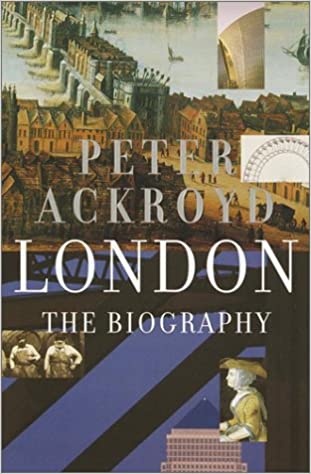
In fact, this current binge view caused me to reach for one of my favorite books of popular history, Peter Ackroyd’s London: The Biography (2001).  Here’s a snippet from the Publisher’s Weekly starred review of the book:

Novelist and biographer Ackroyd (The Plato Papers; T.S. Eliot; etc.) offers a huge, enthralling “biography” of the city of London. . . . Ackroyd examines London from its pre-history through today, artfully selecting, organizing and pacing stories, and rendering the past in witty and imaginative ways. . . . Anglophiles and others will rejoice.

London: The Biography is less a chronological history and more a thematic narrative, drawing generously on contemporary accounts from Londoners known and not-so-well known. Its greatest success is an array of especially vivid depictions of everyday life during the Elizabethan through Victorian eras.

Reading this book, you can practically smell the cooked food from street carts and cheap eateries, and the stinking slop of unsanitary streets. You can picture yourself walking into smoky coffee houses and seeing Londoners of all types conducting their business over “dishes” of the hearty brew. You can imagine the awful living conditions of the working poor and the destitute.  And you quickly grasp that stealing a bit of food or an item of clothing, even out of pure desperation, may lead to harsh and humiliating punishments meted out by an unforgiving justice system.

This is a big book — some 800 pages — but fortunately it can be read selectively and completely out of order, dipping and choosing based on one’s specific curiosities. If you decide to take a look at it, do remember that you’re not reading about a city celebrated for its beauty, such as Paris or Venice. Rather, as Patrick McGrath put it in a review titled “A City Much Like Hell” for the New York Times, this is:

…a loving portrait of a rambunctious monster, warts and all. Of the modern city Ackroyd says it ”can hold, or encompass, anything; in that sense it must remain fundamentally unknowable.” His own great accomplishment in this hugely entertaining volume is to make unknowable London to a large extent knowable — by the inspired selection and deft organization of extraordinary materials, and his spirited prose. He succeeds in animating on the page the lived life of one of the oldest and greatest — if dampest and grayest — cities in the world.


Aristotle’s invitation to consider the people and events material to our lives

As I wrote in one of this blog’s first posts, since last September I have been enrolled in the Basic Program of Liberal Education for Adults, offered by the University of Chicago’s Graham School for Continuing Liberal and Professional Studies. The Basic Program is an open enrollment, non-credit, four-year study of the Great Books of Western Civilization.

There are no exams, papers, or grades. Rather, the main activities are reading and discussion, via weekly classes smartly facilitated by Program instructors. Traditionally offered in face-to-face format at the school’s Chicago center, the Basic Program is now available online as well. (It has been delivered exclusively online during the pandemic.) The online format has made it possible for me to enroll from Boston.

Aristotle’s Poetics

Among the books assigned for our current, second-year autumn session is Aristotle’s Poetics, regarded as the first comprehensive work of literary criticism. Aristotle was an inveterate cataloguer and categorizer of knowledge and information. In this compact work (all of 35 pages, in the edition we’re reading), he identifies and discusses the core properties of literature and poetry, including tragedy, epic poetry, and comedy.

I find it fascinating to read how Aristotle sets out basic elements of storytelling that we now teach from grade school on up. At times he keeps it remarkably simple, telling us that a plot “is a whole if it has a beginning, a middle, and an end” (ch. 7). A little later,  he reminds us that “if the presence or absence of a thing makes no discernible difference, that thing is not part of the whole” (ch. 8). It’s basic stuff that we now may take for granted, but Aristotle helped to give us these elementary frameworks for understanding and creating dramatic work.

The stories of our lives

I also find that Poetics helps me to view my own stories more clearly. For example, the two passages quoted above may seem like statements of the obvious, rather than meaningful insights. After all, it doesn’t take a literary scholar to know that stories and plots — including our own — have a beginning, middle, and end. It also doesn’t take much to understand how people and things that pass through our lives with little impact aren’t core parts of our life stories.

But they serve as easy frames for identifying, sorting, and understanding the stories of our lives. What are those plots? What are their beginnings, middles, and ends? Who are the core players in them? Perhaps I’m especially appreciative because I’ve reached a point in my life where events and people in my life seem to be shaping into coherent chapters. On that note, a short passage from Pathways to Bliss: Mythology and Personal Transformation (2004), by the late Joseph Campbell, is instructive:

In a wonderful essay called “On an Apparent Intention in the Fate of the Individual,” [philosopher Arthur] Schopenhauer points out that, once you have reached an advanced age, as I have, as you look back over your life, it can seem to have had a plot, as though composed by a novelist. Events that seemed entirely accidental or incidental turn out to have been central in the composition.

Making the Great Books your own: Growing in literary literacy or cherry-picking for relevant passages?

Let me confess that I may be guilty here of cherry-picking Poetics to suit my own purposes. Unlike some of Aristotle’s other works, this is not obviously applicable as a self-help volume. And yet I’m juxtaposing two short passages in a way that serves such a purpose for me.

In the Basic Program, our first objective is to understand and appreciate these works as literature. We are expected to read assigned chapters closely before class. During class, oftentimes we read passages aloud and discuss them at length. For many students in the Program, this is a golden opportunity to obtain a classical liberal arts education during the heart of adulthood, and/or to renew a connection with books encountered (and sometimes glossed over, to put it kindly, in my case) in our earlier schooling.

However, as one of our learned Chicago instructors has remarked on several occasions, the Great Books can also work as therapy. In fact, we now have a term — bibliotherapy — that captures how reading works of literature can help people to understand and cope with the ebbs and flows of their own lives. There’s even a book that provides specific reading suggestions, Ella Berthoud & Susan Elderkin, The Novel Cure, From Abandonment to Zestlessness: 751 Books to Cure What Ails You (2013).

Personally, I am happy to combine both programmatic and personal learning benefits in reading these classic books. Unlike some of my more intellectual friends, I am not given to reading great novels and other literary works for their own sake. I need a connection, a point of relevance, to appreciate them more fully. So when a few lines from Aristotle speak to me, I get excited about that. I hope there will be many more such moments during the path of the Basic Program.

Embracing middlebrow culture: The Book-of-the-Month Club

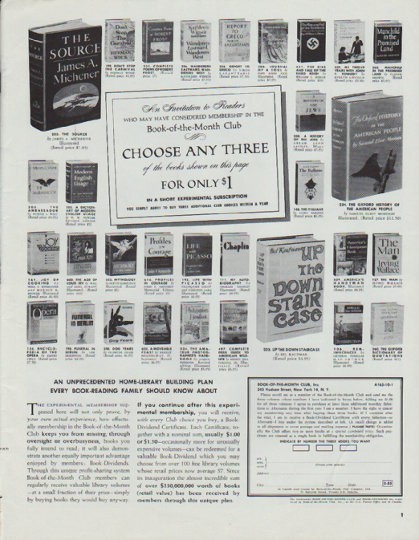
1965 BOMC ad

Not long ago, if you were part of America’s growing middle class and wanted to expand your cultural literacy, the Book-of-the-Month Club (BOMC) was a popular option towards doing so.

Founded in 1926, BOMC was the brainchild of New York ad agency guys who tapped into America’s embrace of mail order and the reading appetites of its upwardly mobile middle class. People typically became BOMC members by answering a magazine ad or a direct mail invitation. The Club’s marketing hook was an initial membership package that offered either a free premium volume or allowed you to select titles from the club’s catalog for a small initial sum. However, you also had to fulfill a membership agreement, which meant buying a specified number of books at club prices within the next two or three years.

Every month, members would receive a packet in the mail, containing a flyer describing the editors’ main selection for that month, a short catalog describing alternate and back list selections, and a reply card. If you did nothing, the main selection would be sent to you. You could also use the reply card to indicate that you didn’t want the main selection or to order alternate and back list selections.

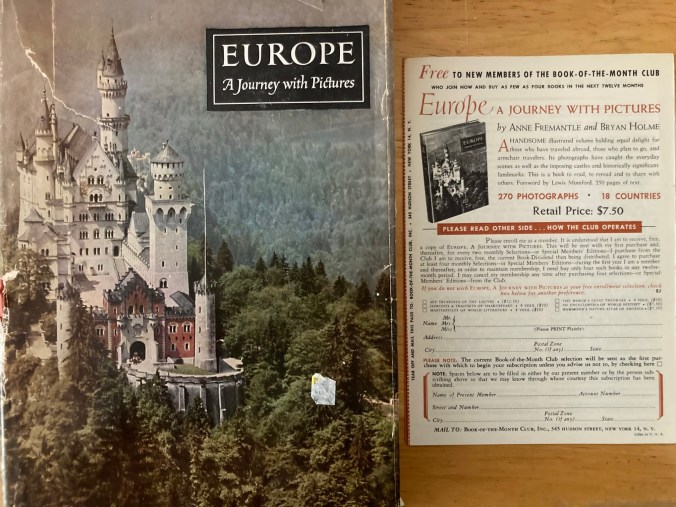
Here’s a premium book once offered to new BOMC members, a 1954 illustrated profile of Europe. I can only imagine the different emotions evoked by this volume, published just nine years after the conclusion of the Second World War.

(photo: DY)

BOMC as a middlebrow cultural broker

BOMC offered a way to bring good books into your home with minimal hassle, screened by reviewers who had discerning eyes for the reading tastes of middlebrow America. Over the years, BOMC assembled various panels of judges to evaluate and select books for its catalog, some of whom were accomplished authors in their own right. During the Club’s heyday, serving as a BOMC selection committee judge carried some prestige within mainstream publishing circles.

Commercially speaking, BOMC was a big deal to authors seeking to broaden their readership. Main selection status signaled a stamp of approval by a trusted brand and a guarantee of higher sales. BOMC favored quality fiction and non-fiction for a general, intelligent audience, while largely avoiding books that might be considered too tawdry or cheesy. Its marketing campaigns played on such appeal and the idea of building a good home library, while usually managing to avoid lapsing into higher-level snobbery.

Among some stuffier types, however, this combination of commercial advertising and middle class reading tastes prompted derision of the whole enterprise (and by implication, perhaps, of its customers). Nevertheless, the Book-of-the-Month Club elevated America’s literary intelligence by bringing good books to an upwardly mobile swath of America’s population.

BOMC bestseller

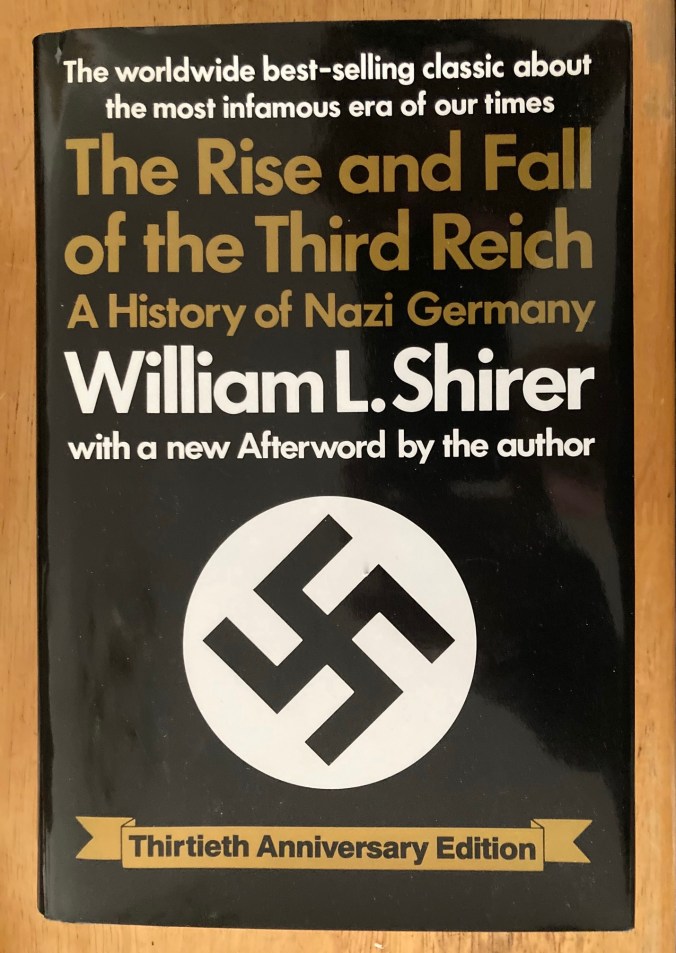
If you’re looking for a sign of where BOMC’s cultural center of gravity rested during its heyday, consider that its bestselling book ever was journalist William Shirer’s The Rise and Fall of the Third Reich: A History of Nazi Germany. First appearing in 1960, it was a publishing phenomenon, stunning industry experts who believed that Americans wanted to put anything to do with the war behind them. The Rise and Fall was a BOMC main selection and a favorite backlist choice for years to come.

 (photo: DY)

Big box and online booksellers

Predictably, the appearance of larger, brick and mortar bookstores and the emergence of online booksellers would spell trouble for the Book-of-the-Month Club. I was an off-and-on member from the 1980s through the early 2000s, and I witnessed its steadily declining commercial and cultural significance in shaping reading appetites.

After briefly shutting down in 2014, BOMC quietly reappeared the next year. Its owner, Bookspan, relaunched the Club as a fully online enterprise, using a streamlined subscription model. Its target readership is younger women who enjoy popular fiction.

When more is less special, and less is more special

I sometimes think about BOMC’s classic sales model as I try to manage my personal and professional book collections.

I’m generally careful in my personal spending, except for when it comes to buying books. On that note, I have little willpower. I can justify rationalize a book purchase on multiple grounds: (1) I want to read it now; (2) I want to read it later; (3) I might want to read it later; (4) It’s on sale; (5) It’s a used bookstore bargain find; (6) It’s useful for my work; (7) It’s a lovely edition of a favorite book; (8) Whatever. As a result, I have many more books than I could ever hope to read, even assuming a comfortable retirement someday and many healthy years to follow.

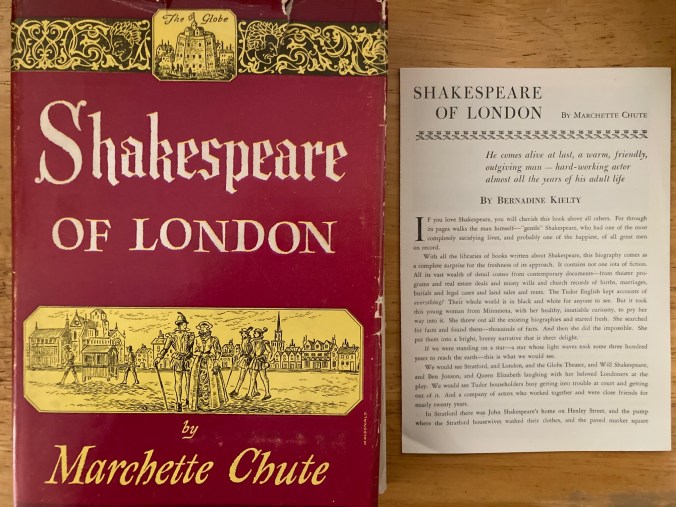
I’m grateful that I can afford to indulge my book-buying habit. I realize, however, that adding multiple books to my home and office libraries each month is not as special as the delicious anticipation of a new book, selected from a curated list. For example, I wonder how cool it was for a hungry reader to receive Marchette Chute’s Shakespeare of London (1949), including a neat little essay accompanying the volume.

(photo: DY)

Highly recommended

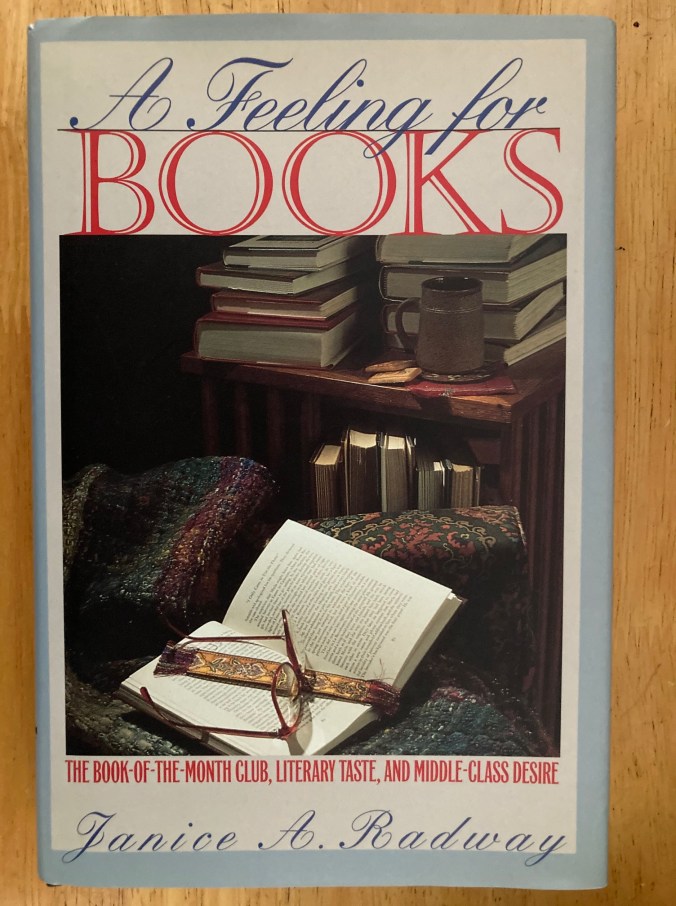
I won’t burden you with further observations about BOMC’s place in America’s 20th century cultural history. If you want to learn more about that story, with a big dollop of personal reading memoir mixed in, then I highly recommend Janice Radway’s A Feeling for Books: The Book-of-the-Month Club, Literary Taste, and Middle Class Desire (1997). Ignore the snarky reviews by those who, for some reason, can’t get over (1) a book that’s good with middlebrow culture; and (2) BOMC’s undeniable profit-making motive. This is an informative and entertaining read.

(photo: DY)

***

Note: Passages from this post were adapted from a 2016 entry to my personal blog, Musings of a Gen Joneser.