The Basic Program at the University of Chicago: “Senior year” beckons

The Big One awaits

This month, I am starting my fourth and final year of the Basic Program of Liberal Education for Adults at the University of Chicago’s Graham School. The Basic Program is an open enrollment, non-credit, four-year sequence of courses featuring the close reading and discussion of what have been called the Great Books. It starts with works by ancient Greek philosophers and poets (e.g., Plato, Aristotle, Homer) and proceeds to examine other canonical authors and works of the Western tradition (e.g., Shakespeare, the Bible, Kant).

Here’s how the Basic Program describes itself:

The Basic Program of Liberal Education for Adults is a rigorous, noncredit liberal arts program that draws on the strong Socratic tradition at the University of Chicago and covers the foundations of Western political and social thought.

***

The starting point for the Basic Program is the Four-Year Core Curriculum. Each year is made up of three 10-week Quarters. New Students begin in Year 1 Autumn. They choose from morning, afternoon, or evening sections held online and earn a certificate upon completion of the entire curriculum.

***

Each section meets for three hours once a week. Class sections consist of: a 90-minute seminar (discussing several texts) with one instructor, a 90-minute tutorial (discussing a single text) with a different instructor, with a 15-minute break in between.

Bucket listed

I had long considered studying the Great Books a personal bucket list item, a significant piece of unfinished business in my education. My undergraduate school, Valparaiso University, is home to an excellent honors college built around the Western canon. But after sampling two of its literature courses as a not very intellectual post-adolescent, I just wasn’t interested in that course of study.  But over the years, I began to feel an increasingly strong tug to give these books a try. On occasion, I would try to read some of these great works on my own. These soon-halted efforts taught me that it wasn’t going to happen outside of a more structured learning environment.

I assumed that retirement might provide me with that opportunity. But perhaps there’s nothing like a global pandemic to help you identify and prioritize your options. I had known of the Basic Program for many years. However, originally it was offered only via in-person classes in Chicago, which precluded my enrollment given my Boston residence. Then, during the summer of 2020, I learned that the Basic Program was being offered online, so I quickly investigated.

Even though there are no papers, quizzes, or exams, class sessions are built around expectations of significant student participation. So if I wanted to make the most of this opportunity, I knew that fairly beefy weekly reading assignments would be part of the deal. Although I quickly grasped that this would be a major commitment — for four years, no less — it was an easy decision to sign up.

I now have three years of the Basic Program under my belt. It has been a stimulating, intellectually rewarding experience. I have enjoyed my fellow students and our instructors. The Program has also required a lot of brain work! During busy times with my own work and philanthropic obligations, keeping up with the reading has been challenging. On occasion I’ve made it to class having basically skimmed the material, which is wholly inadequate preparation for two 90-minute sessions featuring intense and close examination of classic texts. But I’ve never regretted enrolling for a minute.

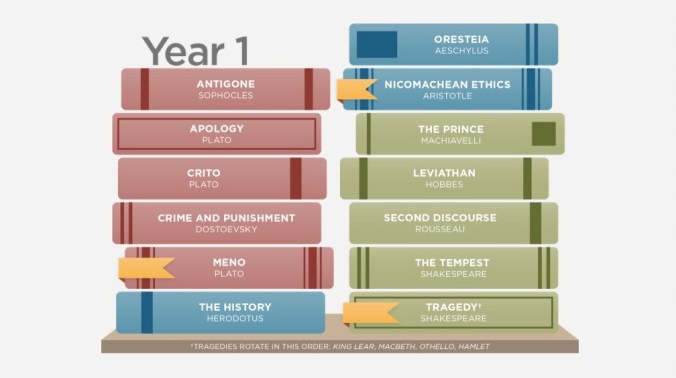
At some point, I will write more about my overall experience in the Basic Program. For now, if you’re curious about what a typical year’s reading in the Program looks like, here is the first-year curriculum. The three colors represent the autumn, winter, and spring quarters. The titles with a banner are for our tutorial courses, which means we spend the entire term on that book alone. The remaining titles are for our seminar courses, which means we cover all or parts of those books, in a more brisk fashion, during the term. (Hamlet, by the way, was our cohort’s Shakespearean tragedy.) For more about the full four-year curriculum, please go here.
“Senior year” beckons

Soon I will join fellow students in our cohort via Zoom to begin what some of us are humorously calling our senior year. In some ways, it feels like we’ve been on quite a journey together already.

During the autumn quarter, our tutorial sessions will be devoted to Thucydides’s History of the Peloponnesian War, written during the late 5th century B.C. This book is a foundational work of history and international relations, chock full of insights relevant to contemporary events. It is required reading at the U.S. military war colleges because of the lessons it holds for understanding modern statecraft.

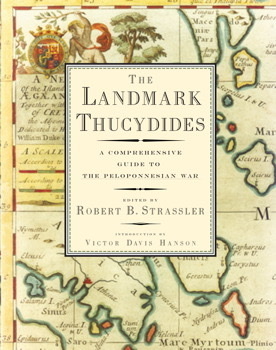
Thucydides has ranked high on my bucket list of books for many years, but an attempt to read it on my own years ago left me rather intimidated. That’s why I was delighted to see it on the Basic Program reading list, knowing that I will benefit from reading and discussing it with my classmates and instructor.  We’ll be using a much-praised edition, The Landmark Thucydides (1998), edited by Robert Strassler, that includes not only a highly respected translation of the primary text, but also lots of supplementary material to fill in our understanding of the pertinent cultural and political dimensions of ancient Greece. 

What else is on the reading list for this term? Our seminar sessions will cover Plato’s Symposium, selected chapters from Plutarch’s Lives of the Noble Greeks and Romans, and Jane Austen’s Pride and Prejudice. Although I encountered the Symposium in college, the other two authors and books are new to me.

And so, a busy “senior year” approaches, to be juggled along with work and other commitments. I hope it is a satisfying and enjoyable journey.
Living history: The 1962 Cuban Missile Crisis as experienced by a U.S. Navy officer on a destroyer

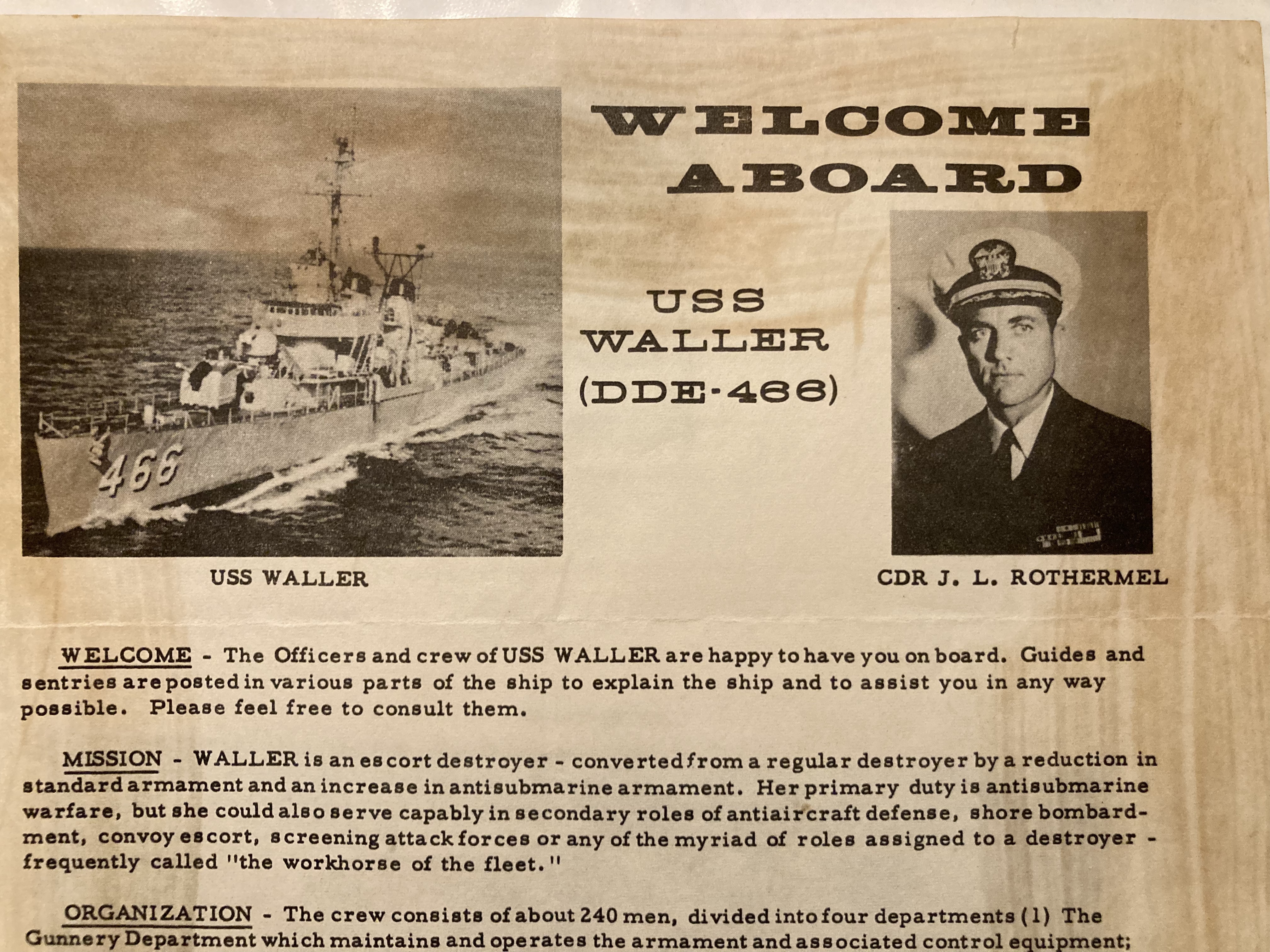
October 2022 marked the 60th anniversary of the Cuban Missile Crisis, a perilous showdown between the United States and the Soviet Union, in which the two superpowers narrowly averted a catastrophic nuclear war. On this Veterans Day in America, I thought I’d share the story of a late friend (and his fellow crew members) aboard a U.S. Navy destroyer, the USS Waller, which served with distinction during that critical episode in our history.

The conflict began when reconnaissance photos taken by a U.S. surveillance plane flying over Cuba revealed the stunning presence of nuclear silos, a clear sign of a potential Soviet nuclear capability within easy striking distance of America.  During a 13-day period, the U.S. and Russia engaged in a taut diplomatic and military chess match that brought us closer to nuclear holocaust than at any other time in human history. Eventually the give and take of diplomacy prevailed, but not before saber rattling between the White House and the Kremlin and U.S. and Soviet naval forces risked a nuclear exchange.

During the Crisis, my friend Brian McCrane (Annapolis ’53) was an officer aboard the Waller, which was assigned to the U.S. Navy task force that created a quarantine zone around Cuba to prevent Russian vessels from reaching the small island. After Brian passed in 2018, his oldest daughter Denise (and one of my dearest friends) gave me several albums she had assembled for him, containing records and mementoes of his service in the Navy. One of these albums is devoted to Brian’s service on the Waller, covering the period of the Cuban Missile Crisis. Reading through it recently, I understood that this was a bit of living history.

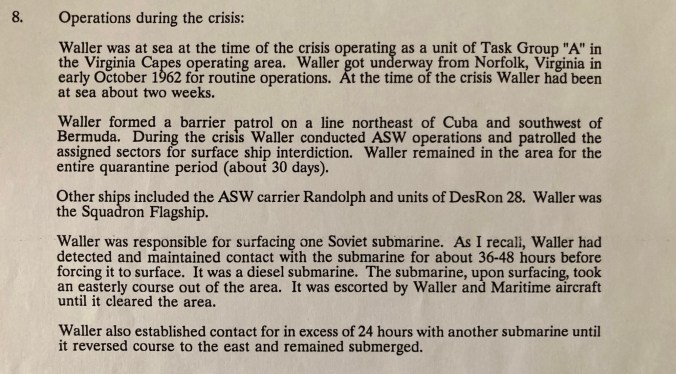
The most significant informational document in the Waller album is a memorandum that Brian prepared in 1992, in response to a request from a military historian who was researching the specific actions of U.S. Navy warships during the Crisis. Brian’s written answers to the historian’s very specific questionnaire tell a dramatic story, but you need to dig beneath a Navy officer’s tight, descriptive verbiage to grasp just how perilous the situation happened to be. I’m pleased to share some of it here, using snapshots from the album.

Brian’s memo starts by giving his dates of service on the Waller and his rank (Lieutenant) during that time.

From the album, here’s a photo of young officers aboard the Waller. Brian is on the far right.

I chuckled when I noticed that Brian was the only one not holding a drink. The son of a man who served in World War I and owned a car dealership in New Jersey, he was an earnest and serious officer, sharply focused on his duties.

Watches stood during Crisis

Here, Brian was asked to list his watches, i.e., the times that he was assigned to specific duties and responsibilities. Let’s break this down.

“Officer of the Deck” means that Brian had significant responsibilities on the ship’s bridge. Wikipedia explains that, in the U.S. Navy, the officer of the deck:

…is a watchstanding position in a ship’s crew…who is tasked with certain duties and responsibilities for the ship. The officer of the deck is the direct representative of the ship’s commanding officer and is responsible for the ship.

“General Steaming” is what it sounds like. No doubt the men were on alert, but there was no immediate threat.

But then we get to “(General Quarters) Condition I ASW,” a ship’s highest state of readiness. A call to General Quarters means that engagement with an enemy combatant is present or imminent. If you’re wondering what this might’ve sounded like on the Waller, the first 15 seconds of this recording will give you an idea:

And “ASW”? That’s anti-submarine warfare. The Waller and other U.S. Navy warships were intercepting and tracking Russian submarines, and now the situation was coming to a head. More on that below.

Fortunately, things did wind down. “Condition II ASW” indicates that a threat is present, but not imminent.

Dramatic action for the Waller

In order to stop the Soviets from delivering more weaponry to Cuba, President Kennedy ordered the Navy to set up a quarantine line designed to intercept Russian ships bound for Cuba. The Waller was among the ships assigned to that task. Brian describes the assignment as a “barrier patrol,” during which the Waller “conducted ASW operations and patrolled the assigned sectors for surface ship interdiction.”

In his compact prose, Brian describes the Waller‘s involvement in one of the most dramatic moments of the Cuban Missile Crisis: “Waller was responsible for surfacing one Soviet submarine.” They had detected a Russian diesel submarine and maintained contact with it for some 36-48 hours. The Waller kept up this cat-and-mouse game, until finally forcing the sub to surface. The Waller and supporting aircraft then escorted the sub out of the area.

So that, dear readers, is part of what “(General Quarters) Condition I ASW” was all about during the Cuban Missile Crisis.

What the U.S. Navy didn’t know

Unbeknownst to the Americans, the Russian submarines were carrying nuclear weapons. Indeed, we now know that another Russian submarine that reached the U.S. Navy’s quarantine line came perilously close to deploying a nuclear torpedo. Again, I draw upon Wikipedia:

At the height of the Cuban Missile Crisis, Soviet patrol submarine B-59 almost launched a nuclear-armed torpedo while under harassment by American naval forces. One of several vessels surrounded by American destroyers near Cuba, B-59 dove to avoid detection and was unable to communicate with Moscow for a number of days. USS Beale began dropping practice depth charges to signal B-59 to surface; however the captain of the Soviet submarine and its zampolit took these to be real depth charges. With low batteries affecting the submarine’s life support systems and unable to make contact with Moscow, the commander of B-59 feared that war had already begun and ordered the use of a 10-kiloton nuclear torpedo against the American fleet. The zampolit agreed, but the chief of staff of the flotilla (second in command of the flotilla) Vasily Arkhipov refused permission to launch. He convinced the captain to calm down, surface, and make contact with Moscow for new orders.

In other words, but for the intervention of one Soviet officer and the cool-headed, deliberate actions of Navy personnel on both sides, nuclear war between the U.S. and the Soviet Union might have started right then and there.

Recognition and reflections

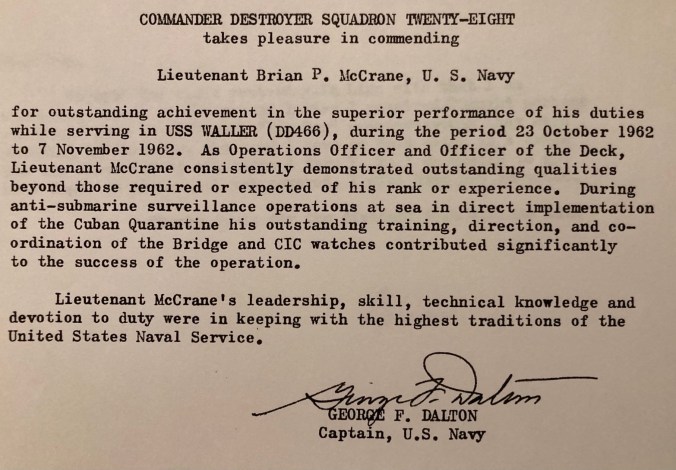
Although my friend Brian was not one to tout his individual recognitions in the Navy, it should be noted that he carried out his duties with distinction during this precarious time. Here is the formal letter of commendation he received in recognition of his performance:

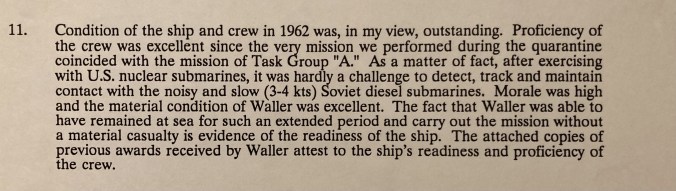
Brian didn’t mention the commendation letter in the memorandum that he prepared for the military historian. However, you will see his brief assessment about the Waller‘s readiness to perform its duties:

Brian’s overall performance would soon lead to the realization of one of his major life aspirations, the command of a Navy warship. In fact, he would become the skipper of two Navy destroyers, the USS Calcaterra and the USS Joseph P. Kennedy. (The Kennedy, by the way, has found a home in Massachusetts, as part of the Battleship Cove museum of U.S. Navy ships in Fall River, not too far out of Boston, where I live.)

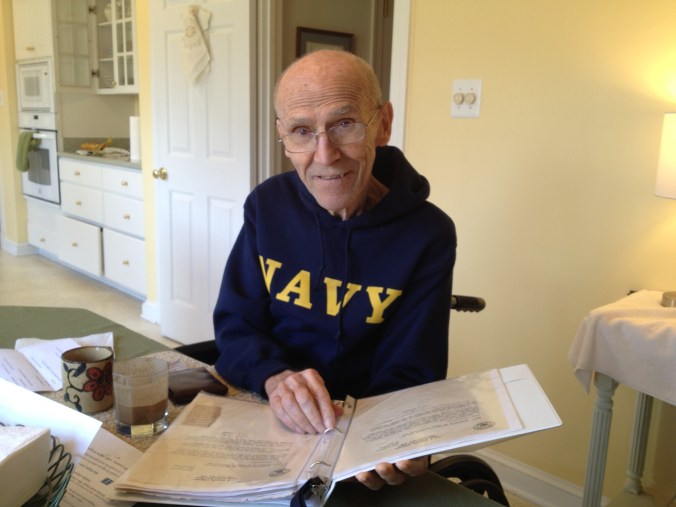
Brian’s years in the Navy would remain among his most cherished set of memories, and many of those he served with would be counted among his dearest friends. Here he is in 2017, about a year before his passing, enjoying one of his Navy albums.

Of course, Brian’s story is just one of millions of those who have served in the military. On this Veterans Day, please allow this lifelong civilian to bow in appreciation of that honorable service. 

“I read the news today, oh boy”: On following coverage of a war in Europe

Screenshot of an Economist subscriber briefing on the Russia-Ukraine war

I sheepishly admit that until a few weeks ago, I had never paid much attention to Ukraine. But once Vladimir Putin’s Russia appeared ready to invade its much smaller neighbor, I sat up straight and quickly realized what was at stake. And all it took was a look at a map plus my (very) rudimentary understanding of global diplomacy and treaty obligations.

Back in October, I wrote about the importance of developing a global orientation, while confessing that I had a ways to go before reaching that state of insight and awareness:

In my more self-deluded moments, I like to think of myself as being something of a “global citizen.” After all, I do some international travel, engage in work that has some transnational relevance, donate to global charities, and gratefully have friends in and from many different countries. Hey, I even subscribe to the Guardian Weekly and The Economist!

In reality, though, I’m yet another professor whose travel experiences, work, and network of friends have international dimensions. I’m just as likely to check on the fortunes of my favorite sports teams as I am to click to news stories of key developments in other parts of the world.

Well folks, it’s interesting that I touted my subscription to The Economist as evidence of a supposed international perspective. Among the news sources I’ve tapped to understand the European situation right now, this magazine is becoming my go-to authority. Its smart, concise, and historically-informed coverage is spot-on for this moment in time. And to think that I considered not renewing my subscription earlier this year!

What’s not part of my news rotation right now is regularly watching television coverage of the war. Fortuitously, I guess we could say, my cable TV service has been off and on, and for various reasons I haven’t scheduled an on-site service appointment. So I’ve been relying on online news sites and print subscriptions to keep me informed.

My verdict? Television news may provide that dramatic, you-are-there kind of coverage, but it’s thin on deeper perspective and endlessly repetitive to boot. It feeds anxiety over the global situation, without delivering a concomitant benefit of more in-depth understanding.

The heroism and suffering of the Ukrainian people,  the actions and intentions of a tyrant in command of a huge military force, and the diplomatic chess game both transparent and opaque have drawn much of my attention. Two weeks ago, I missed a university committee meeting because I had gone down an internet news rabbit hole about the Russian invasion — clicking like mad from site to site and story to story — and didn’t re-emerge until the meeting had concluded!

When the world initially went into shutdown mode during the pandemic, some pundits said this marked the end of an era of globalization that had defined our international outlook since the 1990s. But this war in Ukraine is showing us, with sudden brutality, how we cannot afford to look at our lives through a narrower lens. Memo to self: We are all citizens of the world, whether we choose to admit it or not. Our day-to-day learning and self-education must encompass that global view.

On developing a global orientation

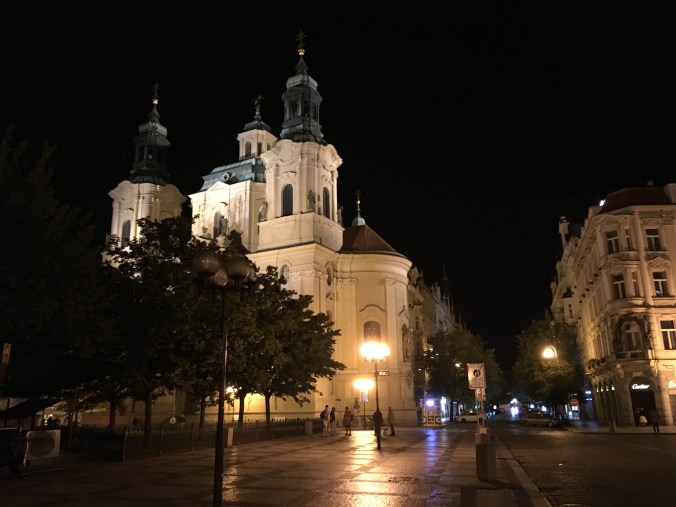
Old Town Square, Prague, Czech Republic, during a 2017 visit for a law and mental health conference (photo: DY)

In my more self-deluded moments, I like to think of myself as being something of a “global citizen.” After all, I do some international travel, engage in work that has some transnational relevance, donate to global charities, and gratefully have friends in and from many different countries. Hey, I even subscribe to the Guardian Weekly and The Economist!

In reality, though, I’m yet another professor whose travel experiences, work, and network of friends have international dimensions. I’m just as likely to check on the fortunes of my favorite sports teams as I am to click to news stories of key developments in other parts of the world.

By contrast, I know a good number of people whom I count as bonafide global citizens. Whether they travel around the world or not, they have a genuine international orientation that gives them a broader perspective on this planet we inhabit. Some, like friends and colleagues connected with the Human Dignity and Humiliation Studies network and the International Society for Therapeutic Jurisprudence, two wonderful organizations on whose boards I serve, devote significant energies toward furthering peace, justice, and humanitarian initiatives around the world.

How can we become more globally oriented citizens? This question has crossed my mind often and seems especially important right now, as we continue to grapple with a global pandemic and face a world increasingly impacted by climate change. Ironically, these developments threaten to turn us inward rather than outward, restricting international travel (a marvelous way of expanding our horizons) and causing us to protect our smaller circles rather than advancing the well-being of the broader global community.

For those of us who have leaned towards being more local or national in our outlook, it requires intentionality to view the world through a wider lens. This includes paying closer attention to news developments from around the world. It means bringing a more inclusive spirit to our lives, one that celebrates variety and diversity and naturally builds bonds with people from other cultures. And, when possible, travel can be part of the picture. In the words of Rick Steves, the popular travel author and educator:

Of course, travel, like the world, is a series of hills and valleys. Be fanatically positive and militantly optimistic. If something’s not to your liking, change your liking. Travel is addicting. It can make you a happier American, as well as a citizen of the world. Our Earth is home to over 7 billion equally important people. It’s humbling to travel and find that people don’t envy Americans.

. . . Globetrotting destroys ethnocentricity. It helps you understand and appreciate different cultures. Travel changes people. It broadens perspectives and teaches new ways to measure quality of life. Many travelers toss aside their hometown blinders. Their prized souvenirs are the strands of different cultures they decide to knit into their own character. The world is a cultural yarn shop.

And, at its most challenging levels, building a global outlook involves trying to understand and address the seemingly intractable differences that are causing so much strife and division today. For as President Kennedy said in his moving and compelling 1963 speech on the urgent need to curb the nuclear arms race:

And if we cannot end now our differences, at least we can help make the world safe for diversity. For in the final analysis, our most basic common link is that we all inhabit this small planet. We all breathe the same air. We all cherish our children’s futures. And we are all mortal.