Embracing middlebrow culture: The Book-of-the-Month Club

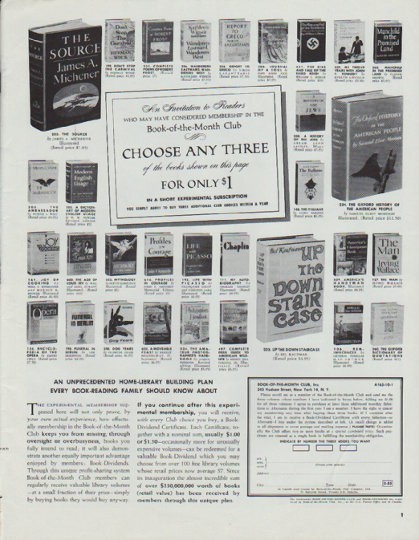
1965 BOMC ad

Not long ago, if you were part of America’s growing middle class and wanted to expand your cultural literacy, the Book-of-the-Month Club (BOMC) was a popular option towards doing so.

Founded in 1926, BOMC was the brainchild of New York ad agency guys who tapped into America’s embrace of mail order and the reading appetites of its upwardly mobile middle class. People typically became BOMC members by answering a magazine ad or a direct mail invitation. The Club’s marketing hook was an initial membership package that offered either a free premium volume or allowed you to select titles from the club’s catalog for a small initial sum. However, you also had to fulfill a membership agreement, which meant buying a specified number of books at club prices within the next two or three years.

Every month, members would receive a packet in the mail, containing a flyer describing the editors’ main selection for that month, a short catalog describing alternate and back list selections, and a reply card. If you did nothing, the main selection would be sent to you. You could also use the reply card to indicate that you didn’t want the main selection or to order alternate and back list selections.

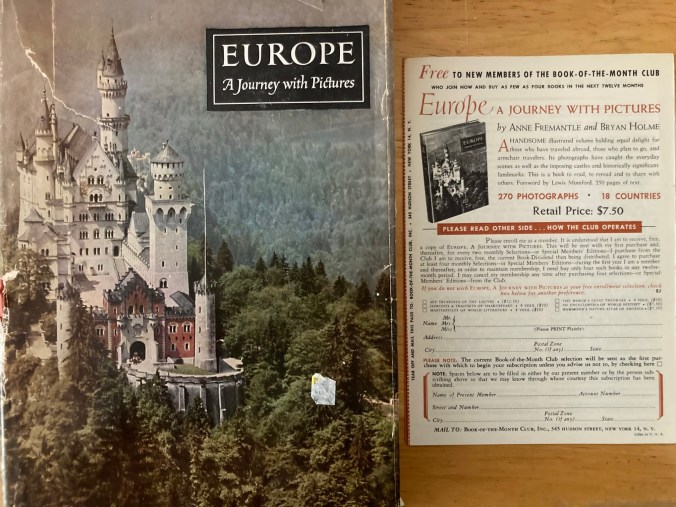
Here’s a premium book once offered to new BOMC members, a 1954 illustrated profile of Europe. I can only imagine the different emotions evoked by this volume, published just nine years after the conclusion of the Second World War.
(photo: DY)

BOMC as a middlebrow cultural broker

BOMC offered a way to bring good books into your home with minimal hassle, screened by reviewers who had discerning eyes for the reading tastes of middlebrow America. Over the years, BOMC assembled various panels of judges to evaluate and select books for its catalog, some of whom were accomplished authors in their own right. During the Club’s heyday, serving as a BOMC selection committee judge carried some prestige within mainstream publishing circles.

Commercially speaking, BOMC was a big deal to authors seeking to broaden their readership. Main selection status signaled a stamp of approval by a trusted brand and a guarantee of higher sales. BOMC favored quality fiction and non-fiction for a general, intelligent audience, while largely avoiding books that might be considered too tawdry or cheesy. Its marketing campaigns played on such appeal and the idea of building a good home library, while usually managing to avoid lapsing into higher-level snobbery.

Among some stuffier types, however, this combination of commercial advertising and middle class reading tastes prompted derision of the whole enterprise (and by implication, perhaps, of its customers). Nevertheless, the Book-of-the-Month Club elevated America’s literary intelligence by bringing good books to an upwardly mobile swath of America’s population.

BOMC bestseller

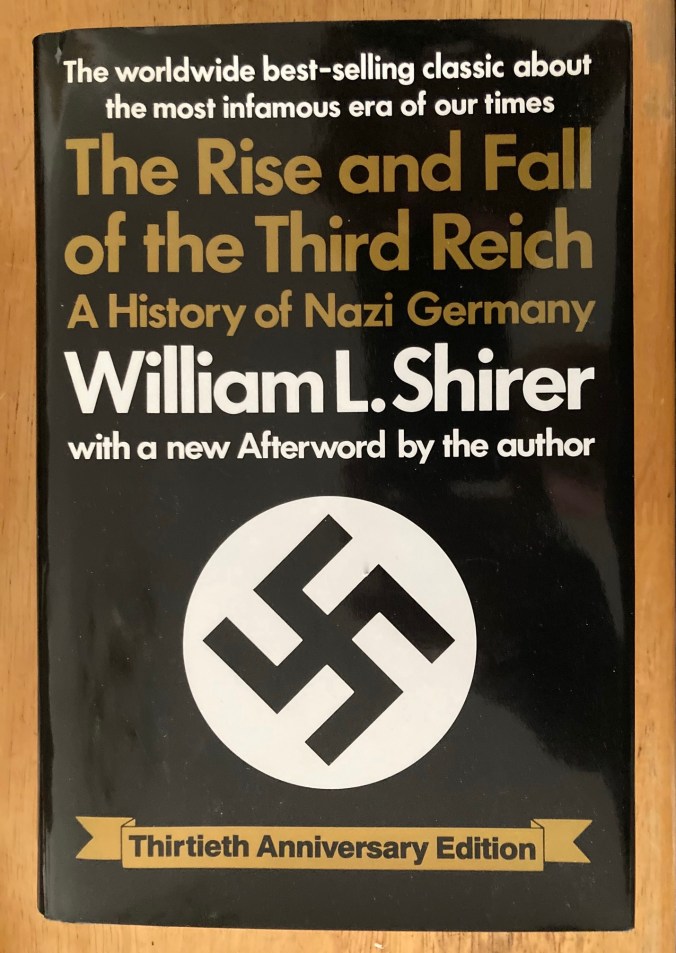
If you’re looking for a sign of where BOMC’s cultural center of gravity rested during its heyday, consider that its bestselling book ever was journalist William Shirer’s The Rise and Fall of the Third Reich: A History of Nazi Germany. First appearing in 1960, it was a publishing phenomenon, stunning industry experts who believed that Americans wanted to put anything to do with the war behind them. The Rise and Fall was a BOMC main selection and a favorite backlist choice for years to come.
 (photo: DY)

Big box and online booksellers

Predictably, the appearance of larger, brick and mortar bookstores and the emergence of online booksellers would spell trouble for the Book-of-the-Month Club. I was an off-and-on member from the 1980s through the early 2000s, and I witnessed its steadily declining commercial and cultural significance in shaping reading appetites.

After briefly shutting down in 2014, BOMC quietly reappeared the next year. Its owner, Bookspan, relaunched the Club as a fully online enterprise, using a streamlined subscription model. Its target readership is younger women who enjoy popular fiction.

When more is less special, and less is more special

I sometimes think about BOMC’s classic sales model as I try to manage my personal and professional book collections.

I’m generally careful in my personal spending, except for when it comes to buying books. On that note, I have little willpower. I can justify rationalize a book purchase on multiple grounds: (1) I want to read it now; (2) I want to read it later; (3) I might want to read it later; (4) It’s on sale; (5) It’s a used bookstore bargain find; (6) It’s useful for my work; (7) It’s a lovely edition of a favorite book; (8) Whatever. As a result, I have many more books than I could ever hope to read, even assuming a comfortable retirement someday and many healthy years to follow.

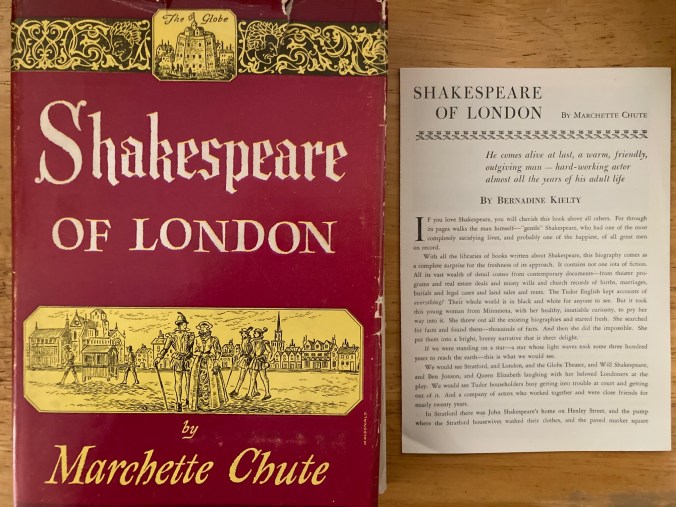
I’m grateful that I can afford to indulge my book-buying habit. I realize, however, that adding multiple books to my home and office libraries each month is not as special as the delicious anticipation of a new book, selected from a curated list. For example, I wonder how cool it was for a hungry reader to receive Marchette Chute’s Shakespeare of London (1949), including a neat little essay accompanying the volume.
(photo: DY)

Highly recommended

I won’t burden you with further observations about BOMC’s place in America’s 20th century cultural history. If you want to learn more about that story, with a big dollop of personal reading memoir mixed in, then I highly recommend Janice Radway’s A Feeling for Books: The Book-of-the-Month Club, Literary Taste, and Middle Class Desire (1997). Ignore the snarky reviews by those who, for some reason, can’t get over (1) a book that’s good with middlebrow culture; and (2) BOMC’s undeniable profit-making motive. This is an informative and entertaining read.
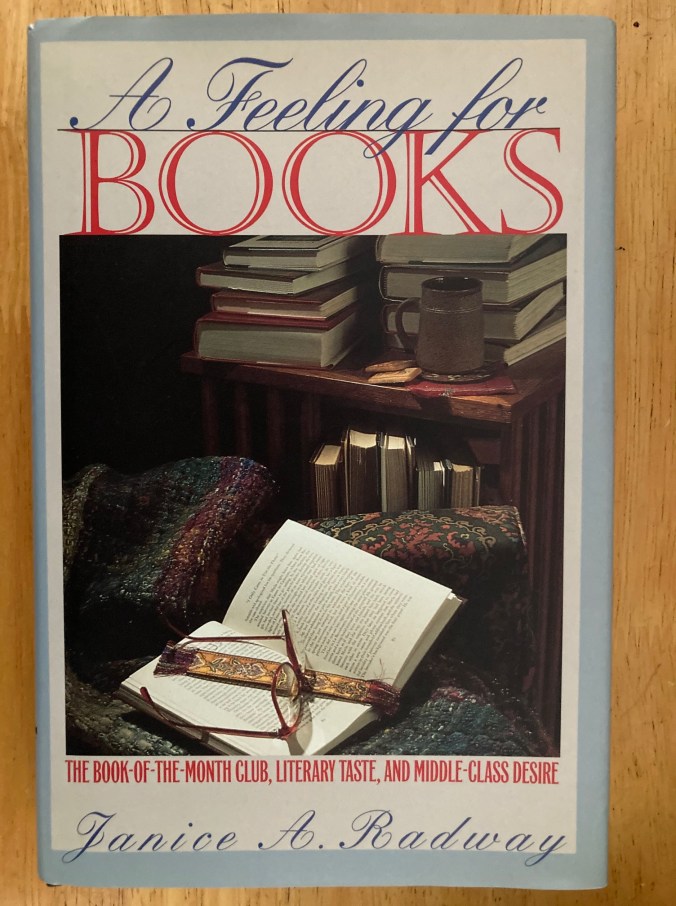
(photo: DY)

***

Note: Passages from this post were adapted from a 2016 entry to my personal blog, Musings of a Gen Joneser.

On developing a global orientation

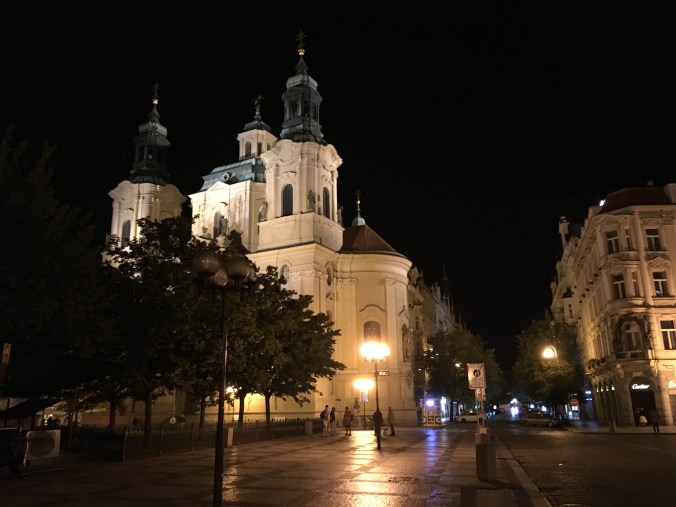
Old Town Square, Prague, Czech Republic, during a 2017 visit for a law and mental health conference (photo: DY)

In my more self-deluded moments, I like to think of myself as being something of a “global citizen.” After all, I do some international travel, engage in work that has some transnational relevance, donate to global charities, and gratefully have friends in and from many different countries. Hey, I even subscribe to the Guardian Weekly and The Economist!

In reality, though, I’m yet another professor whose travel experiences, work, and network of friends have international dimensions. I’m just as likely to check on the fortunes of my favorite sports teams as I am to click to news stories of key developments in other parts of the world.

By contrast, I know a good number of people whom I count as bonafide global citizens. Whether they travel around the world or not, they have a genuine international orientation that gives them a broader perspective on this planet we inhabit. Some, like friends and colleagues connected with the Human Dignity and Humiliation Studies network and the International Society for Therapeutic Jurisprudence, two wonderful organizations on whose boards I serve, devote significant energies toward furthering peace, justice, and humanitarian initiatives around the world.

How can we become more globally oriented citizens? This question has crossed my mind often and seems especially important right now, as we continue to grapple with a global pandemic and face a world increasingly impacted by climate change. Ironically, these developments threaten to turn us inward rather than outward, restricting international travel (a marvelous way of expanding our horizons) and causing us to protect our smaller circles rather than advancing the well-being of the broader global community.

For those of us who have leaned towards being more local or national in our outlook, it requires intentionality to view the world through a wider lens. This includes paying closer attention to news developments from around the world. It means bringing a more inclusive spirit to our lives, one that celebrates variety and diversity and naturally builds bonds with people from other cultures. And, when possible, travel can be part of the picture. In the words of Rick Steves, the popular travel author and educator:

Of course, travel, like the world, is a series of hills and valleys. Be fanatically positive and militantly optimistic. If something’s not to your liking, change your liking. Travel is addicting. It can make you a happier American, as well as a citizen of the world. Our Earth is home to over 7 billion equally important people. It’s humbling to travel and find that people don’t envy Americans.

. . . Globetrotting destroys ethnocentricity. It helps you understand and appreciate different cultures. Travel changes people. It broadens perspectives and teaches new ways to measure quality of life. Many travelers toss aside their hometown blinders. Their prized souvenirs are the strands of different cultures they decide to knit into their own character. The world is a cultural yarn shop.

And, at its most challenging levels, building a global outlook involves trying to understand and address the seemingly intractable differences that are causing so much strife and division today. For as President Kennedy said in his moving and compelling 1963 speech on the urgent need to curb the nuclear arms race:

And if we cannot end now our differences, at least we can help make the world safe for diversity. For in the final analysis, our most basic common link is that we all inhabit this small planet. We all breathe the same air. We all cherish our children’s futures. And we are all mortal.

My problem with The New Yorker — or is it The New Yorker’s problem with me?

A New Yorker cover for our times

For decades, The New Yorker magazine has aspired to excellence in publishing what we now call long-form journalism. Each week, it delivers well-written, deeply-researched, and fact-checked dives into topics both mainstream and esoteric, along with fiction, poetry, reviews, and its legendary one-panel cartoons. A subscription to The New Yorker is something of a mild status symbol, proclaiming that you seek quality commentary about current events and popular culture.

The New Yorker also has a very lively online presence. In addition to publishing its print issue articles online, it adds a lot of content daily, often on breaking news topics. In all, The New Yorker offers a lot to its subscribers.

But here’s my somewhat blasphemous hypothesis: The New Yorker may also be one of the most unread magazines in existence. If my experience is in any way typical (and I freely admit that it may not be so), then a lot of folks get their magazine in the mail, quickly scan the table of contents, and then put it aside with the best of intentions to get to those beefy articles when free time allows. We rinse and repeat with each weekly issue, thus creating a pile in our homes.

Furthering the blasphemy: The New Yorker sometimes says too much about too little. Too many long pieces are overextended explorations by gifted writers who are very close to narrow topics that may not justify the reading time of many readers. Others — such as lengthy explorations of current news topics — may have a very limited shelf life. (I’m not going to give examples, because my purpose is not to trash specific pieces or writers.)

In sum, The New Yorker strikes me as being a writer’s magazine, but not necessarily a reader’s one.

Of course, my problem with The New Yorker could fairly be recast as The New Yorker‘s problem with my limited attention span and my decidedly middlebrow center of cultural gravity. You see, as much as I’d like to think of myself as the kind of reader who devours each issue in order to be both informed and sufficiently erudite, I am not that person.

Many of my day-to-day interests are of a niche variety, and if The New Yorker‘s chosen deep dive niches don’t match with mine, then I’ll likely flip past them. (To be totally fair, I don’t expect The New Yorker to run pieces about my niches, such as my passion for karaoke or my interest in obscure, defunct professional football leagues.) And I tend to rely on newspapers (online editions, these days) for current news and commentary.

From a lifelong learning perspective, The New Yorker implicates the choices we make about our reading. Given X amount of time available for reading, how much of it do I want to devote to lengthy article Y? Using that calculus, I’m on the fence about renewing my subscription.

In any event, I’m confident that my little critique of The New Yorker will not have a negative impact on its readership. I’m good with that. After all, the magazine stands for quality commentary and stringent editorial standards, at a time when the written word needs such strong support.

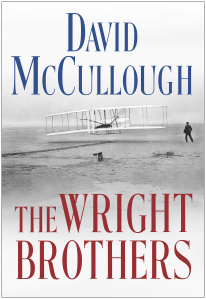
Masterful, self-directed learners: The Wright Brothers

A wonderful, fascinating story.

At this stage of my life and career, most of my learning is self-directed. I know that I share this trait with many other middle-aged adults. This understanding has led me to be thinking a lot about the philosophy and practice of self-directed learning lately. It also has caused me to return to  historian David McCullough’s wonderful book, The Wright Brothers (2015).

Before we dive into the main story, let’s start with a definition. In Self-Directed Learning: A Guide for Learners and Teachers (1975), renowned adult education professor Malcolm S. Knowles defines”self-directed learning” as:

…a process in which individuals take the initiative, with or without the help of others, in diagnosing their learning needs, formulating learning goals, identifying human and material resources for learning, choosing and implementing appropriate learning strategies, and evaluating learning outcomes.

That’s as good a definition as any. It covers what a lot of us are doing to enrich our lives and hone new skills.

It also captures what Orville and Wilbur Wright did on their way to Kitty Hawk, North Carolina in 1903, when they invented and flew the first successful airplane.

Going back to my boyhood days, I had long been familiar with the historic narrative of the two brothers who owned a bicycle shop in Dayton, Ohio and used virtually all of their spare time to learn about flying. I figured that I knew what I wanted to know about that story, until I started reading McCullough’s book and became enthralled.

McCullough writes about how Orville and Wilbur were raised in very modest surroundings by a missionary father who strongly believed in the power of reading, how their sister Katharine strongly influenced and supported their work, and how an intense devotion to teaching themselves the science and mechanics of flight led to their success.

The brothers were smart and eager to learn. Wilbur, notably, demonstrated qualities of genius. Their accomplishments were especially remarkable given that, as McCullough states, they had “no college education, no formal technical training, no experience working with anyone other than themselves, no friends in high places, no financial backers, no government subsidies, and little money of their own.”

At the time Orville and Wilbur were reading the existing scientific studies about the prospects of manned flight and conducting experiments with homemade wind tunnels in their bicycle shop, other more prominent, well-funded, and well-credentialed inventors and scientists were also working tirelessly to become the first to achieve motorized flight. But this did not dissuade the two brothers from pursuing their goal, with a giant assist from sister Katharine. In fact, they would largely rewrite the book on the science of flying. and in the process refute previous theories and studies advanced by many “experts” on aviation.

Talk about self-directed learning…with a learning outcome that was literally airborne and with consequences that would change the world! If anyone doubts the power of self-directed learning, then let Orville and Wilbur Wright be prime examples that prove otherwise.

***

For more about self-directed learning, check out the International Society for Self-Directed Learning and the Alliance for Self-Directed Education.

Some passages in this piece are drawn from a 2015 article about David McCullough and the Wright Brothers posted to my professional blog, Minding the Workplace.

Me, reading Shakespeare?!

(image courtesy of clipart-library.com)

Well folks, if we need any more evidence that life during this pandemic has led us into some unexpected activities, then I submit for your consideration that I have spent the past 10 weeks reading works of Shakespeare. The full period was devoted to Hamlet, while the past two weeks added The Tempest into the mix.

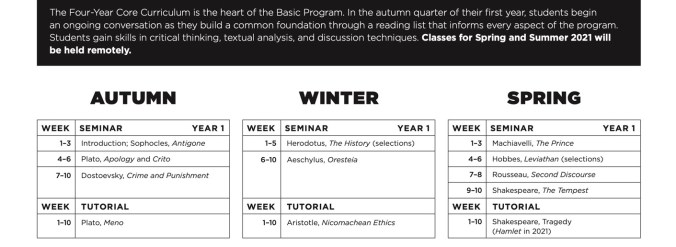
The prompt for this has been my enrollment in the Basic Program of Liberal Education for Adults at the University of Chicago.   As I wrote here back in January, the Basic Program is an open enrollment, non-credit, four-year study of the Great Books of Western Civilization. There are no exams, papers, grades. Rather, the main activities are reading and discussion. Each week during every 10-week quarter, we have a three-hour session, divided between the “Seminar,” during which we examine several works, and the “Tutorial,” during which we study one book intensively.

Gifted University of Chicago instructors who are thoroughly steeped in these books lead these courses, but they do not lecture. Rather, they ask questions and facilitate discussion in a Socratic fashion. The three-hour sessions are intense but often fly by. We covered the following during Year 1:

From the website of the Graham School, University of Chicago, https://grahamschool.uchicago.edu.

Long offered only via in-person classes at the University of Chicago’s Graham School of Continuing and Professional Studies, the Basic Program began experimenting with a distance learning approach a few years ago. Then came the pandemic, and everything went online via Zoom. While the Program will eventually return to providing in-person instruction, it will retain the online format as well.

I decided to enroll in the Basic Program last fall. During recent years, reading the Great Books had become a “bucket list” item, and I was well aware that the Basic Program was a unique, even legendary adult education offering. (To learn more about it, click here.) When the pandemic hit, I knew that I would benefit from having a meaningful, engaging intellectual activity during this time of relative isolation. I decided to go for it.

Which brings me back to Shakespeare. Yup, I avoided these books like the plague during high school and college. But I looked forward to diving into them through the Basic Program. 

I confess, it was challenging. I do not easily digest works written in Elizabethan English. It’s kind of like eating vegetables for me. Without Program’s expectation that we show up to class ready to discuss the week’s readings, I would not have finished either Hamlet or The Tempest on my own. But thanks largely to our awesome cohort of instructors and fellow students, it was a rewarding experience. Vegetables can be good for us, even if we prefer burgers and pizza.

Enrolling in the Basic Program has been one of the unexpected gifts of this otherwise largely difficult time, and I look forward to the next three years of reading and discussing these important works. Most significantly, I’m getting more out of these books as a middle aged adult, because their themes and lessons intersect with life experience and a more mature understanding of human nature. In terms of Shakespeare, I am no better now than as a college student at deciphering Olde English. But I’m appreciating the content and underlying ideas much, much more.

We begin anew with Year 2 of the Basic Program in September. In the meantime, I will devote part of my summer to a Graham School elective offering, a course on the history of Chicago. Having grown up in northwest Indiana — long considered part of “Chicagoland” — and taken many trips into the city, Chicago’s history has fascinated me for many years. Chicago is, I believe, the most quintessentially American big city, with all of the good and bad that comes with it. The University of Chicago is an integral part of that history, so there will be a cool connection to both my past and present in the explorations of this course.

Revisiting a classic: “The Civil War” by Ken Burns

I’ve been thinking a lot about the relevance of the American Civil War (1861-65) to our current political and social milieu here in the U.S. I have been fascinated by the Civil War since my boyhood days and long understood its ongoing significance in defining our civic life. Events of the past five years, in particular, have underscored the war’s continuing hold on this country.

Starting last week, I opted to re-watch Ken Burns’s 1990 award-winning documentary mini-series “The Civil War.” The debut of “The Civil War” was quite the television event in the fall of 1990, captivating millions of viewers who tuned into their Public Broadcasting Service stations over five consecutive nights. I was among them, and I have watched the full series on multiple occasions over the past 30 years.

In terms of production values, Burns set a new standard for historical documentaries. He recruited renowned historian David McCullough to narrate the series. He used well-known actors and other public figures to be the voices of historical figures. He utilized innovative camera work to bring contemporary still photos to life. He interspersed interview segments with leading historians and public intellectuals to provide authoritative commentary on the war. And he wove in popular music of the day to evoke the era, while brilliantly opting for an exquisitely haunting, modern folk instrumental, “The Ashokan Farewell,” to serve as the series theme music. (Listen to it here.)

Although “The Civil War” won dozens of awards and the hearts of reviewers, it also attracted its share of critics. Some claimed it was too sympathetic to the Northern, anti-slavery point of view. But others asserted that it was too soft on the slave-owning Southern side and critical questions of race and racism, feeding into the mythology of the Lost Cause of the Confederacy.

Especially in light of events in the U.S. during the past 15 months, I was curious to gauge my own reaction to this re-watch. How does “The Civil War” hold up against the backdrop of America of the early 2020s? How do criticisms of the documentary play out against our current situation?

Yup, I understand the criticisms that the series is too easy on the pro-slavery South. Historian Shelby Foote, a masterful storyteller who receives a lot of airtime, uses his aw shucks persona to romanticize the Rebel side. He also claims that the main cause of the Civil War was a failure of America’s remarkable ability to compromise, without explaining whether “compromise” includes permitting slavery to exist.

That said, the opening episode of the series devotes considerable time to framing the war in the context of the extraordinary evils of slavery. Also, the series explains how ending slavery increasingly became a central purpose of the Northern cause, in addition to reuniting the nation. Foote’s main counterpart, historian Barbara Fields, helps to take apart the Southern mythology, and her final remarks at the conclusion of the series eerily anticipate our present circumstances.

All in all, I found that “The Civil War” remains a compelling, even epic portrayal of this signature event in American history and a great example of narrative, historical storytelling via film. More than during any previous viewing, it underscored for me the painful reality that, as a nation, we have not resolved the fundamental differences that led to these four years of awful carnage.

Stamps as stories: The Penny Black

In a previous post, I wrote about reviving my boyhood hobby of stamp collecting. As a long-time amateur student of history, I especially love the educative value of stamps that commemorate significant events and individuals. Avid collectors often remark that the ways in which stamps tell stories is one of the great appeals of the hobby, and I heartily agree. 

In addition, some postage stamps constitute historical markers in and of themselves. I offer as a prime example the Penny Black, the world’s first postage stamp, printed in England during 1840-41. As mail service became an increasingly important part of English life and commerce, a British educator named Rowland Hill proposed an easy way of paying for postage, by using bits of printed paper that could be affixed to envelopes. 

Hill’s proposal eventually took hold, and the result was the Penny Black, featuring the profile of Queen Victoria. This marked the beginning of a long British tradition of adorning postage stamps with the profiles of monarchs. However, this took some getting used to, as initially some British subjects found it disrespectful to lick what they regarded as the back of the Queen’s head! Queen Victoria herself intervened to endorse the use of stamps, assuring everyone that no such offense was taken.

For the most part, stamp collecting is a very affordable hobby, at least at my level of engagement. But like any hobby involving collectibles, the rarer, more notable pieces can cost a chunk of change. From an affordability standpoint, the good thing about the Penny Black is that the Brits printed a lot of them, a fair number of which have survived in various conditions. Thus, while select specimens can run into the many thousands of dollars (or pounds, if you’re across the pond!), used Penny Blacks in lesser condition can be obtained at a cost equivalent to picking up the tab for a meal and drinks at a nice restaurant.

Earlier this year, I decided that I wanted a Penny Black as the cornerstone of my budding collection. So, here is my modest specimen, purchased online. It gives me goosebumps to think that this is an authentic piece of Victorian England, having once been affixed to a letter that made its way through the mail system during the 1840s. I can only imagine the story this stamp could tell!

Go online to take free courses from leading professors

If you’re looking for an opportunity to engage in free, college-level learning on topics of personal and professional interest, think about taking a MOOC or two.

MOOC is short for Massive Open Online Course, a form of learning that started to become popular about a decade ago. A typical MOOC is a short-term, non-credit, continuing education course on an academic or professional topic, taught by leading professors in their fields. The course usually mixes online text, pdfs, recorded lectures, and various exercises, quizzes, and tests. Although students enrolled in a MOOC usually do not have direct interaction with the professors who prepared it, they do get the benefit of watching faculty lectures and reading their publications.

You can enroll in most MOOCs for free, though you’ll often have to pay a fee for a formal certificate of completion that can be listed on a resume.

Two of the leading providers of MOOCs are Coursera and EdX.  The UK’s pioneering Open University offers free online courses through its OpenLearn portal. You can also utilize Mooc List to search for other MOOC offerings.

I’ve taken several MOOCs over the years, including “The Science of Happiness,” offered through EdX and taught by professors associated with the Greater Good Science Center at UC-Berkeley, and “Psychological First Aid,” offered through Coursera and taught by a professor at Johns Hopkins University. The Psychological First Aid course is required for students enrolled in my Law and Psychology Lab at Suffolk University Law School.

If you’re interested in exploring the vast array of free courses available online, then I recommend checking out the sites I provided above. They may be of special interest to those of you who are looking for easily accessible, no-cost intellectual pursuits while we continue to get through the coronavirus pandemic.

Lifelong learning by reviving a boyhood hobby

Among US air mail issues, the Diamond Head, Hawaii stamp (bottom row, second from left) is a favorite (photo: DY)

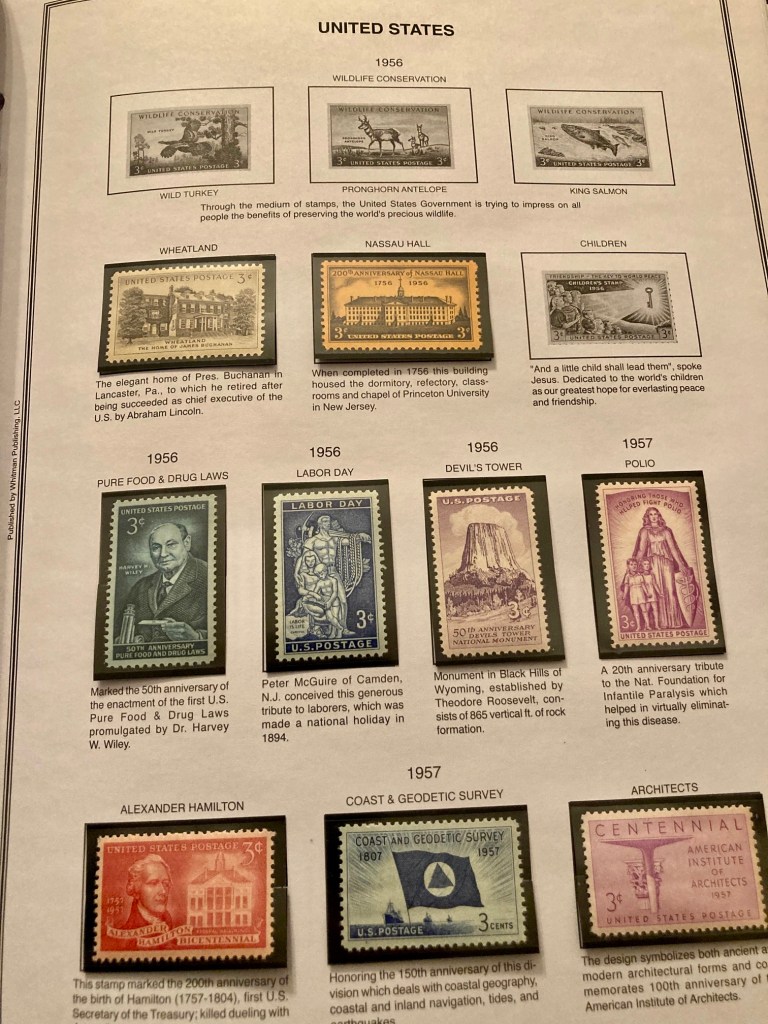
Going back to boyhood days, I have been an inveterate collector. Even many of the hobbies I pursued involved collecting. This included baseball/football/basketball cards, coins, and — spotlight, please — postage stamps. I collected stamps through grade school, and I credit that hobby for nurturing my love of history. After all, stamps, especially commemorative issues, tell stories, often those of notable historical events and figures. You can learn a lot about history by building a stamp collection.

At times I have dabbled in stamp collecting as an adult, but I never truly dove back into the hobby. Until now, that is. During my university’s semester break, the pandemic-induced semi-quarantine that has been my life during the past year prompted me to look into collecting again, and this time it stuck. I now have a couple of new stamp albums, a box of supplies, and subscriptions to a two mail order stamp approval services. I also hunt around eBay for stamp bargains.

All sorts of famous people have collected stamps, including such varied figures as Franklin D. Roosevelt, Amelia Earhart, Warren Buffett, Queen Elizabeth II, Sally Ride, and George Bernard Shaw. But the name that stands out to me is Simon Wiesenthal, Holocaust survivor and renowned Nazi hunter. Three years after the Second World War ended, he began collecting stamps. As explained by the National Postal Museum in Washington, D.C.:

Simon Wiesenthal once wrote that he became interested in stamp collecting in 1948, when he visited a doctor for severe insomnia. “He suggested that I do something at night to take my mind off my troubles, and that’s how I began collecting postage stamps,” Wiesenthal explained. “My hobby has since given me many pleasant hours and helped me to meet people in many countries.”

My life is not remotely as momentous as Wiesenthal’s, but I, too, am already finding that stamp collecting is an absorbing and relaxing hobby as an adult. The subjects captured on the stamps themselves stoke my curiosity, and the process of sorting and placing stamps into my albums has a therapeutic effect. I have a pretty strong feeling that I’ll continue this satisfying and educational hobby, even after it’s safer to be out and about again.

I love US commemorative issues from the post-WWII through mid-60s. Mini works of art. (photo: DY)

What’s behind “More Than A Song”?

So why name a blog about lifelong learning and adult education More Than a Song? A couple of stories provide the answer to that.

A Beginning Voice

Back in the spring of 1995, I was finishing my first year of teaching at Suffolk University Law School in Boston, where I had accepted an appointment as an entry-level assistant professor. It had been a grueling and sometimes stressful year. It started with a move from New York to Boston during the previous summer, followed by a heavy load of classes that required new course preps.

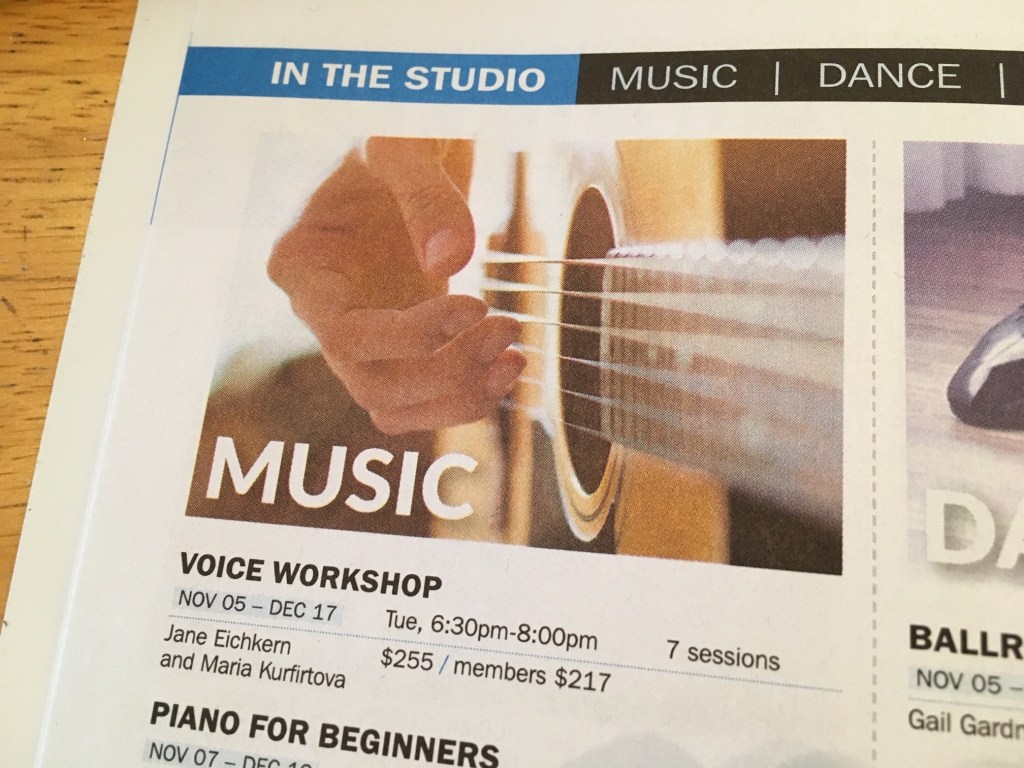
As the school year was coming to an end, I was looking for something fun, different, and distinctly non-legal to do. I had picked up a catalog from the Boston Center for Adult Education (BCAE) and saw a course listing for “Beginning Voice,” accompanied by a short description explaining that learners would sing in a mutually supportive setting. Although I had never done any formal voice instruction before, I had always enjoyed singing, and from the description I assumed this would be like a group chorus experience. On a whim, I signed up.

On a Tuesday night in May, I showed up for the first class, and I was in for a surprise. Jane, our Juilliard-trained instructor, explained the course format: Each week, students individually perform a song of their choice to piano accompaniment and then are coached in front of the group.

From the songbooks that Jane brought to class, I picked a Cole Porter classic, “I Get a Kick Out of You” (featured in the show Anything Goes). Eventually I got up and went to front of the room. Bruce, our accompanist, started to play, and I managed to channel Sinatra finish the song. After polite applause, Jane gave me a few coaching tips, and I sat down, extremely relieved.

Despite my initial shock over the class format, I returned for the remaining sessions. In fact, I registered for every session of the class thereafter, until the BCAE closed its doors in December 2019 because of budgetary and other issues. That class covered 25 years of my life! My repertoire revolved around the Great American Songbook, singing old standards made famous by the Gershwins, Cole Porter, Rodgers & Hammerstein, and other prominent 20th century composers and lyricists.

I’ve reached a point where I’m a decent singer, so this activity has definitely included personal growth and development, not to mention a lot of fun and source of valued friendships. Singing has also become a form of therapy, a sort of mindfulness practice. It’s about being in the moment and stepping away from everyday ups and downs.

I don’t have any great singing ambitions. We plan to revive the voice class at another adult education center once the current pandemic crisis is over. Regular karaoke sessions and occasional open mic/cabaret nights have become part of the mix as well. (At this writing, karaoke has gone online — a surprisingly fun option!) These modest activities aside, singing with friends has become an important part of my life.

A Friend’s Memoir

John Ohliger (1926-2004) was an iconoclastic, pioneering adult educator, activist, and public intellectual. John’s wide-ranging career included the fostering of a unique, self-styled non-profit entity called Basic Choices, Inc., located in Madison, Wisconsin and described as “A Midwest Center for Clarifying Political and Social Options.” Prior to that, he held a tenured professorship in adult education at Ohio State University. In 2002, he was inducted into the International Adult and Continuing Education Hall of Fame.

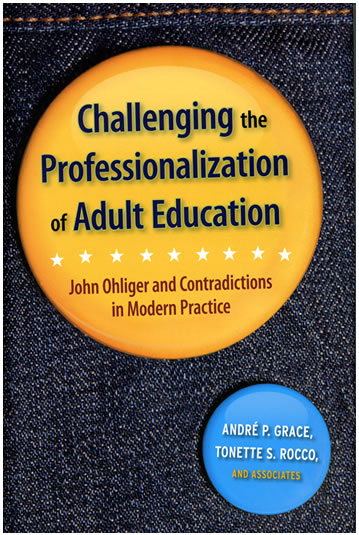
John was also a cherished personal friend. Although we met in person only twice — via visits to Madison and Boston joined by wonderful company of John’s wife, Chris Wagner — we maintained an ongoing friendship through hundreds of email exchanges and collaborated on several projects. After John’s passing, his work was the subject of a unique collection of essays edited by Andre Grace and Tonette Rocco, Challenging the Professionalization of Adult Education: John Ohliger and Contradictions in Modern Practice (2009). I was delighted to contribute a chapter to the book, “The Adult Educator as Public Intellectual,” which can be accessed here.

Although I knew that John pursued an eclectic array of personal, intellectual, and artistic interests, I was nonetheless mildly surprised when he crafted his unpublished memoir around the framing theme of music and song. Titled My Search for Freedom’s Song: Some Notes for a Memoir, he repeatedly built the short chapters using anecdotes about the role of music in his life.

When I read it, however, I understood. This was no artificial literary device. Music and song were ongoing parts of his life. It became altogether clear why John chose this theme for his memoir.

Epiphany

Perhaps with the exception of my friends from voice class and karaoke sessions, many folks in my life are likely to associate me with the work I’ve been doing for many years as a law professor. (See my Minding the Workplace blog for a taste of that work.)

And yet, when it came to naming this blog, I found myself bowing to John Ohliger’s framing device of music and song. My life of learning has included both, in abundance. Music has always been a meaningful part of my personal culture. Singing has become my favorite pastime, thanks to voice class and karaoke. I mean, think about it, I took a group voice class for some 25 years, with the same teacher and an ongoing cohort of fellow students — and I’d still be doing so now if things were different.

So, dear reader, welcome to More Than a Song. I hope it will provide you with insight, entertainment, and inspiration to pursue your own life of learning.